Finland ranks 6th among 38 OECD countries on a new national vitality index from the consultancy MDI, funded by Sitra. On the sub-score that looks ahead fifteen years, measuring R&D spending, GDP growth and employment, it ranks 24th, and has remained weak for a decade and a half. Read alone, that looks like a country losing ground everywhere at once. It isn’t. It’s an average, and this one is hiding a real split.
Defence is the timeliest example. Tesi published a new survey on 25 August 2026 identifying 574 Finnish defence companies, roughly 200 of them defence or dual-use startups actively pursuing strong growth, and another 40 established players with defence as their core business. Tesi’s research lead described an unusually high share of these companies as growth-seeking, with employment in the sector expanding around 9 percent a year.
Finland joined NATO in 2023. A separate Tesi study conducted after that shift found dual-use companies posting revenue growth of 30 to 40 percent, though the report stopped short of tying that growth directly to NATO membership itself. Whatever the exact mix of causes, the sector is visibly larger and more active than it was two years ago.
Deep tech offers another example, with health tech showing how Finnish structural advantages can translate into globally relevant companies. Finnish deep tech funding reached close to €1.6 billion in 2025, a 170 percent increase. Within health tech, Finland has an unusual advantage: population-level health data that can help companies validate products domestically before taking them to larger markets. Companies such as Oura and Aiforia show different versions of how Finnish health and technology expertise can become global businesses.
Neither defence nor deep tech proves a multi-year national turnaround. But both show real, current activity inside the same economy whose long-term vitality indicators remain weak. Finland clearly has pockets of world-class company-building capability. Those pockets are simply harder to see in an aggregate score.
Why they emerge in some places and not others is worth a hypothesis rather than a conclusion. Defence and health tech may show what happens when strong Finnish technical capability meets unusually strong external demand or structural advantage: a defence market on a firm upward trajectory in one case, unusually valuable health data infrastructure in the other. A Slush survey adds another possible factor: 56 percent of founders name risk-averse culture, not tax, as a reason they’d consider leaving. That’s a real signal, but one plausible contributing factor among several, not proof that culture alone explains the stall.
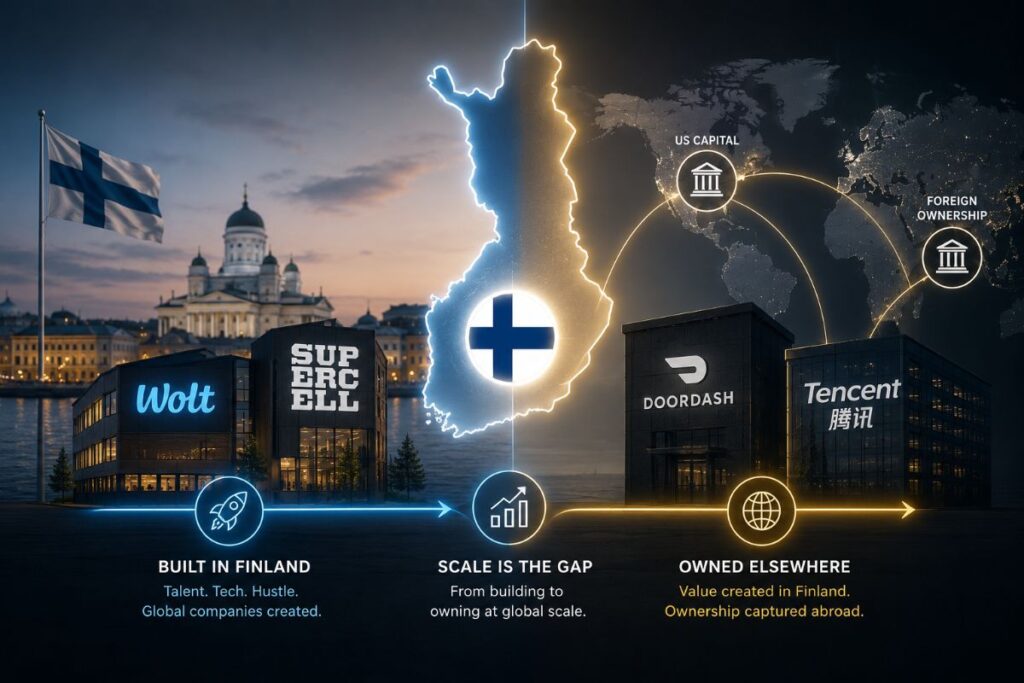
Wolt and Supercell show how far Finnish company-building capability can go, and where a different question starts. Wolt was built in Helsinki and sold to DoorDash for $8.1 billion; Supercell was built in Helsinki and has been under Tencent’s controlling ownership since 2016. Both are genuine Finnish successes that created global companies and substantial wealth for founders, employees and early investors.
But neither is Finnish-owned today.
That doesn’t make either outcome a failure. It raises a different question: once companies built here reach global scale, where do the capital, ownership and strategic control ultimately sit?
It’s a question that extends beyond Finland. Europe matches the US at the early stage of company-building and falls behind at the growth stage, with nearly three-quarters of the investors behind Europe’s breakout AI companies being American. Finland’s experience sits inside that broader European pattern. The continent can produce companies worth owning. The harder part is financing and retaining more of that ownership as they scale.
One thing argues against treating any of this as fixed. In April 2026, after a decade of lobbying, Finland reformed its employee stock option taxation, moving the tax point from exercise to sale. People organized, pushed for years, and the system moved. That’s evidence that the environment can change when the right people push for it, on tax, and potentially on the deeper questions of capital and scale too.
Finland has already proven it can build companies the world wants to buy. The next question is whether it can also build the capital, ambition and conditions required to keep more of them.
Sources
MDI / Sitra, EVPY national vitality index, reported by Yle, 25 August 2026
Tesi, defence sector survey, 574 companies, tesi.fi, 25 August 2026
Tesi, Finnish defence and dual-use market study, 30-40% dual-use revenue growth, tesi.fi (PDF), September 2024
Tesi, Deep Tech Study Finland 2025, €1.594 billion raised, 170% increase, tesi.fi (PDF), December 2025
Slush, Finnish Founder Survey Results, 53% considering relocation, 56% cite risk-averse culture, slush.org
Finnish Startup Community, stock option tax reform announcement, startupyhteiso.com, 22 April 2026
DoorDash, completion of Wolt acquisition, $8.1 billion, ir.doordash.com, 1 June 2022
SoftBank Group, Tencent consortium to acquire up to 84% of Supercell, group.softbank, 21 June 2016
Prosus / Dealroom.co, State of AI in Europe: The Invisible Giant, prosus.com, 16 March 2026
Related Relefy coverage
The Hardest Market to Sell Into, and Why That’s the Point, 5 May 2026
The Thing Holding Finnish Founders Back Isn’t “Just” Taxes, 29 April 2026
Finland’s Startup Community Just Got What It Fought Ten Years For, 26 April 2026
Three Continents. Three Priorities. One AI Race, 21 May 2026