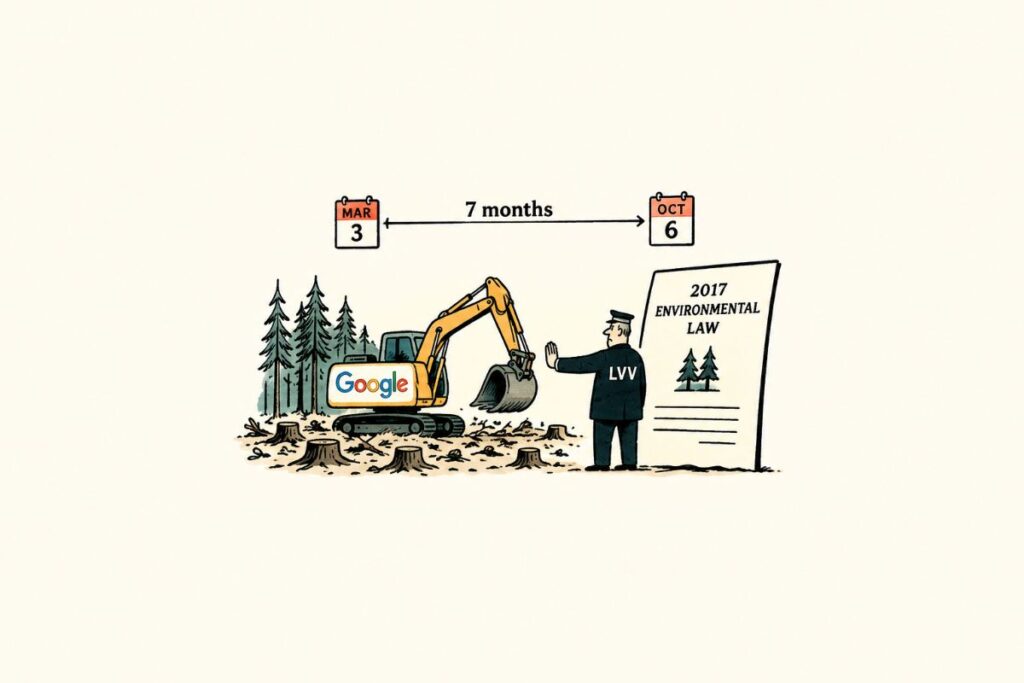

For two years, Finland negotiated with data center investors as if it had to pay them to come. September tested that assumption, and the assumption failed.
This series has followed one question since July: who decides how Finland’s contested electricity gets used. In August we found three mechanisms answering it at once: parliament, the grid queue and municipal land deals. On 10 September we found a fourth, the biggest buyer building its own wing onto the system. This month the question changed shape. It is no longer how Finland attracts the investment. It is what Finland can ask of it.
The subsidy test
On 1 July, data centers lost their reduced electricity tax. The rate rose from 0.05 to 2.24 cents per kilowatt hour, worth about €47 million a year to the state. The government had promised a replacement: a support scheme capped at roughly €30 million a year for data centers of high economic value.
At its budget session at the start of September, the government dropped that scheme. Prime Minister Petteri Orpo (National Coalition Party) said that, given the wider questions around energy supply, it was no longer a priority. According to STT, Finance Minister Riikka Purra (Finns Party) had opposed it, and even the industry’s own lobby had considered it pointless as designed.
Eight days later, on 9 September, Google announced at least €13 billion of infrastructure investment in Finland, its largest in Europe.
The obvious misread is that tax never mattered. That does not follow. Google has run its Hamina data center since 2009, and decisions of this size are made years before a budget session. The narrower point is the one that counts. For a year, the industry warned that ending the tax break would drive investment away. XTX Markets, a London algorithmic trading firm, said it was reviewing a planned €1 billion Finnish data center over the change. Then the largest single commitment in the country’s history arrived with neither the tax break nor its replacement. Nordea’s economists had predicted as much: Finland’s power prices, climate and networks were competitive enough without subsidies.
So if Finland is not selling subsidies, what is it selling?
What Finland is actually selling
Time to power.
In the United States, the binding constraint on AI infrastructure is no longer chips. It is the wait for a grid connection. In Northern Virginia, the world’s largest data center market, the average wait has reached seven years, according to JLL’s 2026 outlook. Across PJM, the grid operator covering 13 states and Washington DC, the time from application to operation has grown from under two years in 2008 to more than eight. In April, Maine banned new data center construction outright.
That is the context for Donald Trump’s reaction. On 14 September he wrote that Google was building in Finland because US permitting was too difficult, and that he wanted the company to change its thinking. Google has given no sign of reconsidering. His complaint is not evidence that the deal is good for Finland. It is useful because it names the scarce asset. Pexapark, a firm that tracks European power purchase agreements, reaches the same conclusion from market data: connection speed now decides where data centers go, and the Nordics stand out.
Scarce assets carry bargaining power. This one also depreciates. In August we reported how Fingrid’s connection limits in Uusimaa pushed Nebius’s expansion from Mäntsälä to Lappeenranta. Fingrid’s half-year review counted roughly 100 gigawatts of data center connection inquiries, against a national peak of about 16. Most will never be built, but Finland’s advantage exists only because its queue is shorter than Virginia’s. When the queue fills, the leverage goes with it.
The next question is what the leverage should buy. That depends on where the system is actually weak, and the most common answer is the wrong one.
Finland is not Ireland
The loudest warning is Ireland. The citizens’ initiative launched in mid-September cites it, and Heikki Vestman’s bill is modelled on Irish regulation.
Ireland’s problem is real. Data centers used 22 percent of its metered electricity in 2024 and 23 percent in 2025, and Irish households paid the EU’s highest prices. A study commissioned by the environmental groups Friends of the Earth Ireland and Beyond Fossil Fuels estimates that data center demand raised household bills from 2015 to 2023. The per-household figure is disputed, reported as both €360 and €263, and the Irish industry rejects it. The mechanism matters more than the number. Three conditions combine in Ireland: heavy concentration, gas setting the price in more hours, and an island grid with only 1,500 MW of links to Great Britain.
Finland has none of the three at Irish scale. Data centers used about 2.3 percent of its electricity at the end of last year, rising to 5 or 6 percent by 2030 on the operators’ own projection. In 2025, Finnish supply came 37 percent from nuclear, 26 percent from wind and 14.5 percent from hydro, with gas under one percent, inside the wider Nordic market. Households paid about 22.5 cents per kilowatt hour against Ireland’s 40.4, and businesses the lowest prices in the EU.
“Finland becomes Ireland” is the wrong fear. The right one is narrower.
Supply is not fixed
First, one assumption has to go: that data centers compete with households for a fixed pool of electricity. They are financing new generation, and the companies can be named.
Google has contracted 629 MW of new wind from Valorem and Suomen Hyötytuuli, plus a 94 MW battery near Kajaani, alongside the Loviisa life extension we covered in September. Amazon has bought the entire output of two wind farms that the Swedish developer OX2 is building for €700 million, the 367 MW Rajamäenkylä and the 105 MW Honkakangas. That takes Amazon’s Finnish contracts to 772 MW, and Amazon does not plan a data center in Finland at all: new Finnish generation with no Finnish data center load attached. Equinix, the global colocation operator with five data centers around Helsinki and Espoo, buys 85 percent of the output of the 35 MW Björkliden wind farm from Neoen and Prokon.
A Fingrid expert estimated that covering data center demand at a 6 percent share would take roughly 430 to 500 turbines of about seven megawatts. Finland has around 2,000 today. The contracts above add up to roughly 1.4 GW, about 200 such turbines. By our rough arithmetic, that is 40 to 45 percent of the upper-end requirement, already signed. Part of it serves Amazon’s Swedish data centers, so the match to Finnish load is loose. The direction is not.
The pie grows. That settles the annual question. It does not settle the hourly one.
The problem is hours, not totals
A wind contract matches energy over a year. It does not deliver power on a calm, freezing January evening, and that is where Finland’s real price risk sits.
The clearest evidence comes from modelling by the consultancy AFRY for the government’s data center review, led by rapporteur Veli-Matti Mattila. AFRY assumed new onshore wind would be built in step with data center demand, exactly the added supply described above. In the baseline scenario, prices did not rise. In the strong-growth scenario, with data center load near 2,500 MW by 2030, the annual average rose by roughly 10 percent even with production keeping pace. The cause was a small number of hours: around 100 a year above 50 cents per kilowatt hour, about 30 of them reaching 90 cents. Data centers draw power at a constant rate regardless of price, so their load lands on the scarcest hours as heavily as on the cheapest. The 10 percent is a modelled scenario for the wholesale price, not a forecast of household bills, which also carry transmission fees and taxes.
The winter margin shows why those hours matter. Fingrid’s outlook, published last week, puts demand on an extremely cold, calm day at about 15,200 MW, against at most 12,000 MW of domestic production. The rest must come from Sweden and Estonia, and Fortum is temporarily bringing its Meri-Pori coal plant back to get through the winter. Mikko Kuivaniemi, who heads Fingrid’s power system reserves unit, says Finland urgently needs new flexible capacity. At the other end of the year, Finland recorded 459 negative-price hours in 2025 and curtailed nearly 300 GWh of renewable output. For most of the year the problem is surplus.
So both political lines miss. On the day of the Google announcement, Orpo told Finns not to worry about prices, and in the same appearance said a household price cap for crises is being prepared. The alarmists fear damage the numbers do not show. The government’s own study shows a rise that is plausible, but concentrated, measurable and addressable.
The public has named its price
Finnish opinion is already moving toward conditions. In a poll by Iro Research, commissioned by Toivo, a think tank close to Orpo’s party, most respondents backed data center construction on one condition: that the companies also invest in power generation and infrastructure. The Datakeskukset kuriin citizens’ initiative opened on 15 September, six days after Google’s announcement. It passed 10,000 signatures in under a day and the 50,000 needed for parliament within days. It asks for grid connection conditions covering capacity, backup power and waste heat, plus a fee based on the electricity, water and land a facility uses. Heikki Vestman, a National Coalition Party MP on the Economic Affairs Committee, has a bill signed by more than 100 MPs that would bar large data centers from connecting until they bring new generation and enough flexibility or demand response of their own.
These instruments aim at different problems. A resource fee prices annual consumption. The costly problem is the hundred hours. Of the three positions on the table, only Vestman’s bill names flexibility, and flexibility is the part the evidence says matters most.
Three horizons
The argument so far covers two time frames. Now, Finland holds unusual bargaining power because fast grid access is scarce internationally. From 2027 to 2030, as the announced data centers come online, the practical problem is peak-hour flexibility. There is a third horizon, and September touched it too.
On 14 September, Finland joined France’s nuclear deterrence initiative. It is a defence arrangement with no energy component. The two are not unrelated, though. France’s civil and military nuclear industries overlap: EDF’s small reactor, Nuward, was co-developed with Naval Group and TechnicAtome, the firms that build the French Navy’s propulsion reactors. Alliances have already shaped reactor choices elsewhere. Poland picked Westinghouse over French and Korean bids, and Washington framed it as an extension of the security partnership. Fortum, the majority state-owned utility that runs Loviisa, has concluded that new Nordic nuclear will not be built on market terms. If it needs state backing, the vendor becomes a state choice, and state choices follow alliances. In the long run, Finland’s capacity question may also become a security-policy question.
None of that touches the second horizon. Fortum puts Finland’s first small reactors 10 to 15 years away. EDF’s programme reportedly lists Finland among five host countries, with first power targeted for 2035. The data centers arrive in 2027 and 2028. Whatever fills the winter gap this decade will be batteries, demand response, backup generation and imports, not reactors.
What the leverage is for
Finland does not need to pay data centers to come. It holds an asset the largest buyers cannot find at home. They are already bringing annual energy, often voluntarily. What they are not yet bringing is what decides whether households notice: capacity that shows up, or load that steps back, in the few hours a year when the system is tight. So far, Google’s 94 MW battery is the only commitment of that kind, and it is small next to the load being added.
That points to a specific ask. Not a bigger fee, and not a ban. A condition on the scarce asset itself: connection comes with flexibility attached. That means batteries, contractual curtailment in peak hours, and backup generators that serve the grid rather than sit idle.
Finland’s bargaining position will probably never be stronger than it is this autumn, with the subsidy gone, the investment committed and the queue still shorter than Virginia’s. The Economic Affairs Committee, Fingrid, the municipalities selling land and 50,000 citizens are all reaching for the same lever from different ends. The open question is whether any of them uses it before the queue fills and the leverage is gone.
Sources
-
Bloomberg: Google Plans €13 Billion AI Infrastructure Buildout in Finland (9 Sep 2026)
-
Yle: Ylen lähteet vahvistavat: Datakeskuksille ei tule uutta tukea
-
Uusi Suomi: 30 miljoonan verotuki kaatui
-
Turun Sanomat / STT: Hallitus sai budjettiriihen valmiiksi päivässä
-
Suomen Uutiset: Datakeskukset (tax change figures)
-
Computer Weekly: Finland government tax proposal worries datacentre investors
-
Nordea: Finland: Data centers
-
Spencer Ogden: Why Are Data Centers Waiting Years for a Grid Connection?
-
The Tribune / ANI: Trump “not happy” with Google’s Finland AI plan
-
Dainik Jagran: Trump Questions Google’s €13 Billion Finland AI Investment
-
Pexapark: A Data Center Tale: The Hunger for PPAs
-
Suomen Kuvalehti: Etuoikeus energiaan
-
CSO Ireland: Data Centres Metered Electricity Consumption 2024 and 2025
-
Eurostat: Household electricity prices H2 2025 and Non-household prices H2 2025
-
Friends of the Earth Ireland and Beyond Fossil Fuels: The Cost of Data Centres
-
Irish Times: Data-centre energy demand adds hundreds of euro to home electricity bills, study claims
-
TheJournal: Ireland’s data centre energy drain
-
Wikipedia: List of high-voltage transmission links in Ireland
-
Uutissuomalainen / Keski-Uusimaa: Fingridistä arvioidaan…
-
Energiateollisuus: Sähkövuosi 2025
-
Energyboard: Electricity prices in Europe
-
DataCenterDynamics: Amazon signs PPA with OX2 for 472MW and Equinix signs 30MW+ wind PPA in Finland
-
Yle: Amazon buys up all electricity from huge wind farms in western Finland
-
Anadolu Agency: Rapid data center expansion in Finland could push electricity prices up 10% by 2030
-
Fingrid: Electricity is expected to be sufficient this winter (Sep 2026)
-
STT / Fingrid: Sähkön arvioidaan riittävän talvella
-
Solarplaza: How congestion and negative prices affect Nordic project revenues
-
MTV Uutiset / STT: Suomalaiset: Datakeskukset sopivat yhdellä ehdolla
-
KU: Kansalaisaloite datakeskusten sääntelystä kerää allekirjoituksia hurjaa vauhtia
-
Yle: Datakeskuksille rajoituksia vaativa kansalaisaloite etenee eduskuntaan
-
Keski-Uusimaa: Uusi lakialoite laittaisi datakeskuksille tiukat ehdot sähkön suhteen
-
SSS / STT: Suomi liittyy Ranskan ydinpelotealoitteeseen
-
US Department of State: Poland’s Announcement on Westinghouse Nuclear Technology Selection
-
Fortum: Uudessa ydinvoimassa on kyse kasvusta, kilpailukyvystä ja työpaikoista and Ensimmäinen pienydinvoimala Suomeen 10–15 vuoden päästä?
-
Discovery Alert: EDF Plans 10 SMRs Across Five Countries