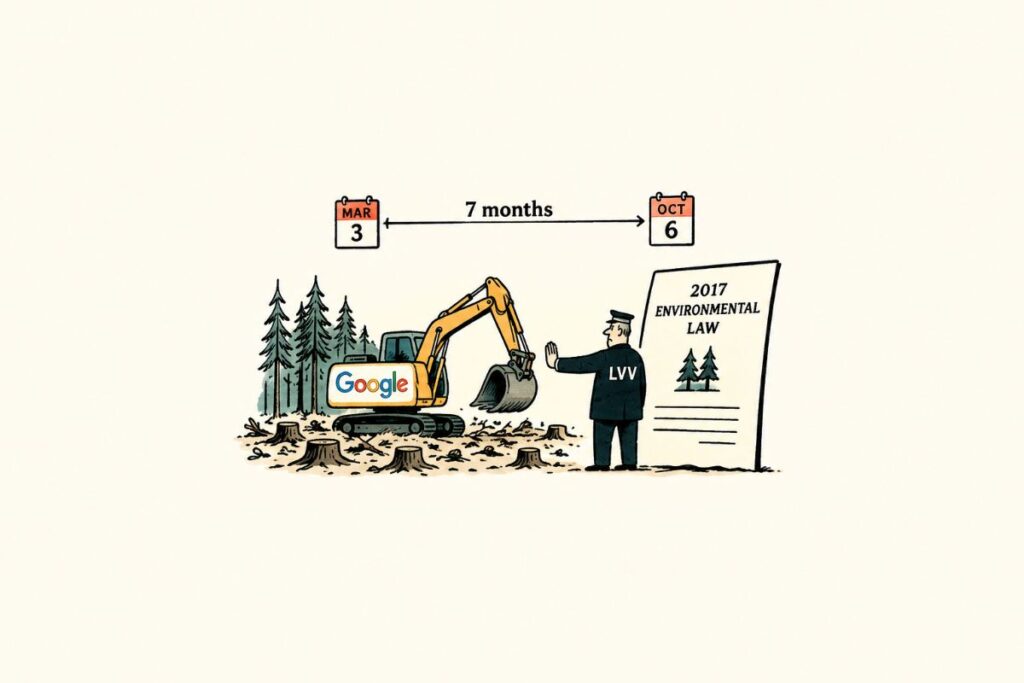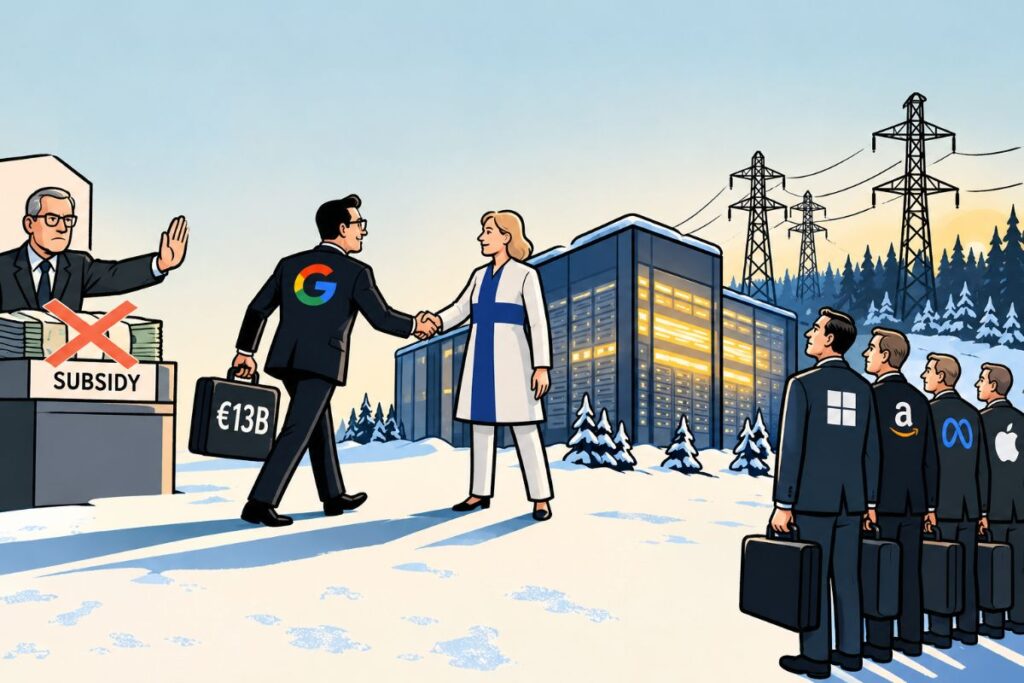
Every industrial era eventually runs into the same problem: something it needs becomes scarce, and someone has to decide who gets it first. For coal, it was land and labor. For oil, it was shipping lanes and refineries. For the AI economy, the scarce resource is turning out to be electricity, and Finland is one of the first countries forced to decide, in public, who gets priority access to it.
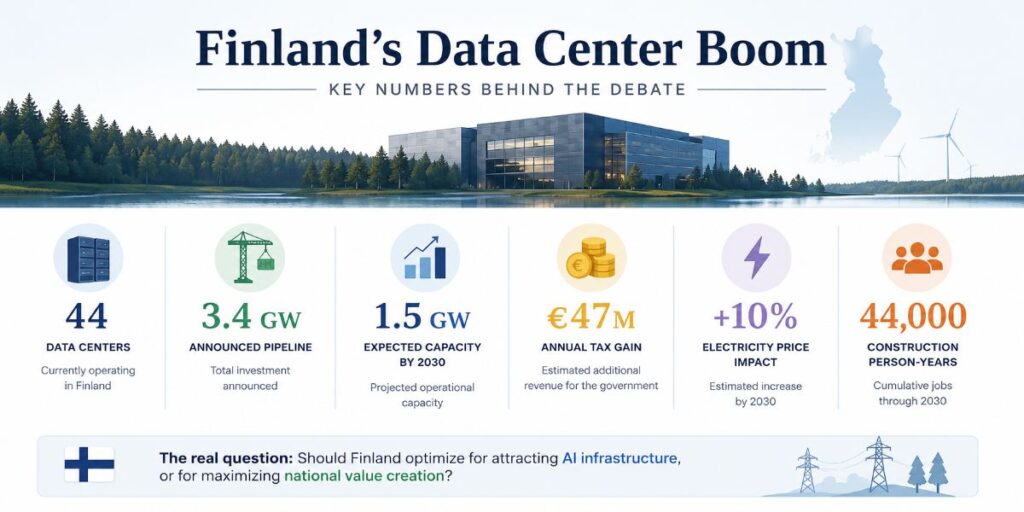
That is the real question sitting underneath Finland’s data center boom, and it is bigger than the tax fight currently making headlines. Should a country optimize its infrastructure and policy around attracting AI compute, or around maximizing long-term national value creation? Those two goals look aligned on a pitch deck. In practice, they compete for the same grid connections, the same construction workers, and the same political attention, and Finland is discovering that nobody, not even its own government, agrees on which one should win.
The immediate trigger was smaller. On July 1, Finland’s data centers lost their tax break: the electricity tax rate jumped from 0.05 cents per kilowatt-hour to 2.24 cents, a roughly 40-fold increase, moving data centers out of the discounted industrial bracket and into the standard rate everyone else pays. The government expects about 47 million euros a year in new revenue.
That number is almost incidental. What it exposes is not.
A boom nobody has agreed on the value of
Finland has built one of Europe’s fastest-growing data center markets in three years. Capacity has grown from 285 megawatts in 2025 toward a projected 1.5 gigawatts by 2030, with 3.4 gigawatts of investment announced. Google, Microsoft, TikTok, and a widening field of Nordic developers have bet on Finland’s cold climate, cheap renewable power, and stable grid.
Markku Heikura, Director-General of Finland’s Tax Administration, doesn’t think the trade has paid off. Speaking to Hufvudstadsbladet in May, he cited his own registry data: most data center companies sell services within their own corporate group or directly abroad, so little profit gets taxed inside Finland, and in several cases the state pays out more in deductions than it collects. The employment case, he added, is thinner than advertised. Finland has 44 data centers. Seven employ more than 20 people. One, Google’s Hamina facility, employs more than 100. Heikura is worried enough about grid reliability that he bought himself a diesel generator, a striking detail from a sitting official whose job is to track the state’s own books.
Four months earlier, the industry had commissioned a very different accounting. Ramboll, a credible consultancy with no obvious reason to inflate its findings, modeled the sector’s impact for the Finnish Data Center Association and the Confederation of Finnish Industries: 44,000 cumulative person-years of construction employment through 2030, 9,900 annual operational jobs by the same year once contractors and knock-on effects are included, and 400 million euros in annual tax impact by 2030. One figure in the report stands as a genuine, checkable rebuttal to Heikura: Google’s Finnish subsidiary, Tuike Finland Oy, paid an average of 20 million euros a year in corporate, payroll, and property taxes between 2018 and 2023.
Neither side has actually dismantled the other’s core fact. What the report’s own numbers reveal, though, is how much weight rests on definition. Its operational jobs figure is mostly external contractors and multiplier effects, not headcount at the facilities themselves, which is closer to Heikura’s picture than the industry’s framing suggests. The dispute isn’t really about whose numbers are wrong. It’s about how broadly you’re willing to draw the boundary of “benefit” before the concept stops meaning anything specific.
The jobs argument is real, and it’s also self-interested
Two voices have carried the employment case loudest this year, and both have a direct stake in the answer. Marko Holopainen, CEO of Bravida Finland, a building-technology contractor, points to data center construction permits up 4.5 times and construction starts tripling since 2024, much of it landing in labor-surplus regions like Kajaani, Hamina, and Kouvola. Minna Arneal, industry director at Staffpoint, a Finnish staffing firm, compares the construction boom to Helsinki’s Länsimetro project and cites the same Ramboll figures: 500 workers at peak for a mid-sized project, up to 1,500 for a hyperscale build.
Their numbers are real. Their interest in the numbers is equally real, and it points in one direction: both profit from the construction phase specifically, and both concede, in their own words, that the phase they’re describing doesn’t last. Arneal’s own figures put operational employment at roughly a quarter of construction employment. Holopainen’s own word for permanent jobs at a large facility is “dozens.”
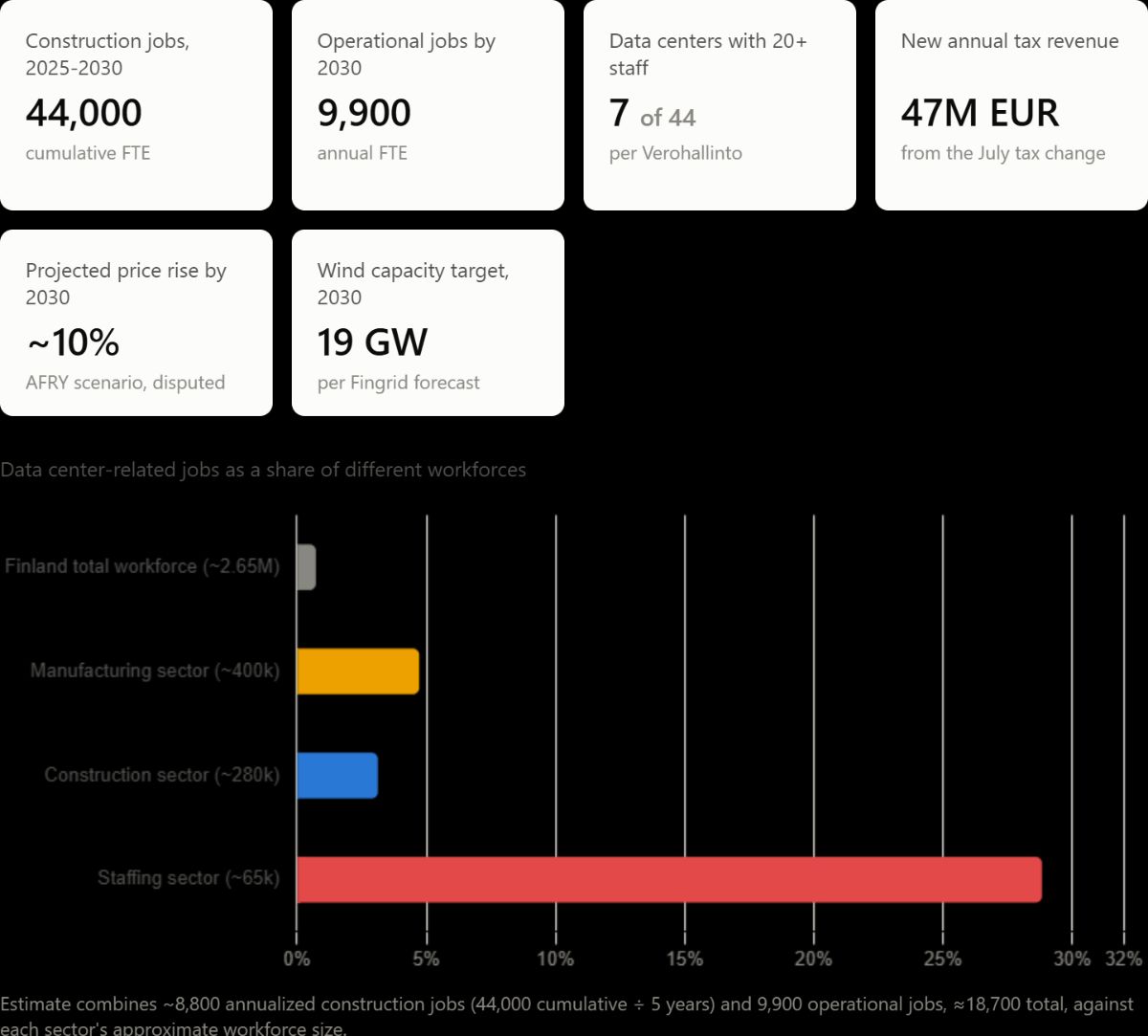
Scale changes what these numbers mean. Finland’s staffing industry as a whole runs on an estimated 60,000 to 70,000 person-years annually, and data centers’ 44,000 cumulative construction jobs through 2030 is a genuinely significant slice of that, which explains why Staffpoint’s advocacy is so specific and so loud. Set against manufacturing, still Finland’s largest employment sector at roughly 19 percent of the workforce, somewhere between 320,000 and 500,000 people, the same numbers shrink to a rounding error. Data centers are a meaningful event for the staffing and construction sectors. They are close to invisible as a labor-market story for the country as a whole.
Nobody claims manufacturing loses jobs to data centers directly. What it risks losing is quieter and less visible in any Finnish account so far: priority in the grid connection queue, and insulation from price volatility. For evidence of what that actually costs, Finland has to look at what’s already happened next door.
Electricity prices: two credible mechanisms, pointing in different directions
Björn Wahlroos, a prominent Finnish financier, argued in Kauppalehti that data centers are quietly achieving what European energy markets have chased for decades: price convergence. Capacity-hungry data centers migrate to wherever power is cheapest, narrowing the gap between markets. Finland had the cheapest wholesale power in Europe last year, about 4 cents per kilowatt-hour against a roughly 9-cent regional average. If his logic holds, Finnish prices should climb toward that average over time.
Pasi Kuokkanen, CEO of the consumer group Elfi, called that reasoning static, arguing it ignores what new demand does to supply. His view: reservoir levels probably shape short-term Finnish prices more than data centers do, and long-term, new consumption is precisely what makes new production investable. Two people with direct financial stakes in the answer back him. Veli-Matti Mattila, the government’s own data center rapporteur, points out that data center operators are nearly the only actors currently signing long-term renewable power purchase agreements in Finland. Vattenfall’s CEO Iiro Rinta-Jouppi says his company’s Korsnäs offshore wind project needs prices closer to the European average before it clears investment, meaning today’s cheap power is itself an obstacle to building tomorrow’s supply.
This is the actual mechanism behind the industry’s favorite talking point. Data centers rarely buy off the spot market. Companies like Google and Microsoft sign long-term contracts with developers before construction starts, and that guaranteed demand is what banks require to finance new wind and solar capacity. Fingrid’s own 2024 forecast reflects the scale of this bet: wind capacity under construction or contracted is set to climb from today’s level toward 19 gigawatts by 2030 and 34 gigawatts by 2035, tied explicitly to industrial consumption growth, including data centers.
That mechanism doesn’t resolve the dispute so much as complicate it usefully. A government-commissioned AFRY study estimated that if data center consumption reaches 2,500 megawatts by 2030, average Finnish electricity prices could rise about 10 percent, with peak hourly prices spiking to 50-90 cents per kilowatt-hour during roughly 100-130 hours a year. Wind, however, is weather-dependent, and Fingrid’s own forecast concedes Finland won’t reach full self-sufficiency in this period, meaning imports will still be needed during exactly the low-wind, high-demand stretches where AFRY’s spikes would land. Both effects can be true simultaneously: a real renewable buildout financed by data center demand, and real price spikes during the hours that buildout can’t cover. What’s missing from the debate is any attempt to translate either effect into what an average household actually pays. That gap is itself a finding.
What this costs once it stops being abstract
Finland has argued nearly all of this in tax brackets and job estimates. Sweden has already produced the concrete version.
Julia Velkova, a media and culture professor at Linköping University leading a research project on data centers and energy, frames the underlying tension bluntly: should scarce electricity go to hospitals and homes, or to generating AI images. In Katrineholm, Amazon’s data centers have become the town’s single largest electricity consumer, reserving roughly a quarter of local grid capacity without confirming it will use all of it. In Malmö, a bakery called Pågen had to relocate a planned expansion because a nearby Microsoft facility had already claimed the available grid capacity. In Norway, a TikTok data center blocked planned expansion at Nammo, an ammunition manufacturer scaling up production tied to the war in Ukraine, a server farm for an entertainment app outcompeting a munitions plant for grid access during a live European war, decided on nothing more than who filed the connection request first.
Finland doesn’t have its own Pågen monent yet, but it’s a likely scenario with Finlands vast food manufacturing industry. It has the same mechanism running underneath it. Fingrid has already restricted new grid connections over 10 megawatts in southern Finland until 2027. And Finland’s version of the Nammo story is already playing out politically rather than physically: Hyperco’s Kouvola and Lohja projects, with TikTok anchoring Kouvola, have drawn direct opposition from government ministers on security grounds. Different justification, same underlying question, who gets priority access to Finnish infrastructure, that Sweden and Norway have already answered the hard way.
Velkova’s prescription is simple: treat digital infrastructure’s grid demands with the same transparency and prioritization logic applied to other critical infrastructure, rather than as a private matter between a developer and a grid operator. It’s also worth noting who is shaping the public argument against that kind of scrutiny. A Helsingin Sanomat investigation found that two members of Helsinki’s city executive board, Niilo Toivonen and Marcus Rantala, work for lobbying firms whose disclosed clients include Google and TikTok, while sitting on the board that decides where data centers can be built in the city. Both say they recuse from anything Helsinki-specific. Toivonen published a piece praising data center investment days before taking part in a related board decision, and Miltton, his employer, advertises exactly the kind of service, stakeholder mapping to identify optimal project locations, that sits uncomfortably close to a council seat. It doesn’t prove the public case for data centers is bought. It does mean some of the loudest voices making that case have a financial interest in how the argument lands, which is worth remembering every time the debate is framed as settled.
The bottleneck isn’t really electricity. It’s priority.
Construction firms and staffing agencies are winning real, bounded, near-term gains from this boom. The renewable energy sector may end up the largest and most durable winner of all, if the power-purchase-agreement mechanism keeps working the way Fingrid’s forecast assumes. Manufacturing isn’t losing jobs to any of this, but it may be losing something quieter: standing in the grid queue, and protection from price spikes nobody has bothered to price out for the people who’ll actually pay them. Finland’s own tax chief doesn’t think the fiscal math works. The industry’s own commissioned study says it does, using a definition of benefit broad enough to reach jobs three steps removed from any data center payroll.
Every industrial revolution eventually competes over whatever has become scarce. What’s different about this one is that the scarce resource isn’t a raw material sitting in the ground somewhere, it’s the electricity already running through a country’s own grid, and the competition for it plays out between industries that used to have no reason to compete at all: a bakery against a server farm, a munitions plant against a streaming app, a tax administration against its own government’s growth strategy.
Finland hasn’t had its Pågen moment yet. But the question it’s actually facing isn’t whether the July tax hike was fair. It’s whether the country decides, deliberately and in public, which industries get priority access to its electricity, or whether it lets that decision get made by default, one grid connection application at a time, until the answer is obvious only in hindsight.
Finland’s data center bet, by the numbers
Sources
Finnish Government, tax bracket change announcement, 26 June 2026: https://valtioneuvosto.fi/en/-/government-safeguards-finland-s-competitiveness-in-attracting-data-centre-investments
Suomen Uutiset, Koskela on tax change: https://www.suomenuutiset.fi/datakeskusten-sahkovero-nousi-koskela-jattimaisen-sahkonkulutuksen-laskua-ei-pida-sysata-tavallisille-suomalaisille/
DataCenterDynamics, Google Kajaani/Muhos hesitation: https://www.datacenterdynamics.com/en/news/plans-on-hold-for-google-data-center-in-finland-following-potential-electricity-tax-raise/
Computer Weekly, XTX Markets and tax proposal: https://www.computerweekly.com/news/366632004/Finland-government-tax-proposal-worries-datacentre-investors
Anadolu Agency, AFRY study on price impact: https://www.aa.com.tr/en/energy/general/rapid-data-center-expansion-in-finland-could-push-electricity-prices-up-10-by-2030-study/52706
Kauppalehti (HBL via Kauppalehti), Heikura interview: https://www.kauppalehti.fi/uutiset/a/66d5aca2-5b1e-4a40-87b3-dafbf86c43a4
FDCA/EK, “Unlocking Finland’s Data Center Potential” (Ramboll report), September 2025 [uploaded PDF]
Kauppalehti, Holopainen op-ed on employment: https://www.kauppalehti.fi/uutiset/a/34222d56-42af-4aa0-a4a8-cd114f629504
Kauppalehti, Arneal/Staffpoint interview: https://www.kauppalehti.fi/uutiset/a/5baa9302-f5c4-4609-8b81-f0efd28aff2a
Henkilöstöala HELA, staffing sector statistics: https://henkilostoala.fi/
EURES, Finnish labour market employment shares: https://eures.europa.eu/living-and-working/labour-market-information/labour-market-information-finland_en
Kauppalehti, Wahlroos/Kuokkanen/Mattila/Rinta-Jouppi on prices: https://www.kauppalehti.fi/uutiset/a/f723bd07-4eab-44ad-981f-b4dc7d4b6158
Fingrid, “Prospects for future electricity production and consumption,” Q3/2024 [uploaded PDF]
Kauppalehti, Taipale/Hyperco op-ed: [link pending, article not yet pasted in full]
Linköping University, Velkova interview: https://liu.se/en/news-item/the-battle-for-power-who-has-the-right-to-our-electricity-
Helsingin Sanomat, Toivonen/Rantala lobbying investigation: https://www.hs.fi/tutkiva/art-2000012079932.html
Kauppalehti, Mikkola/Poikola op-ed: [HS opinion piece, source document provided directly]