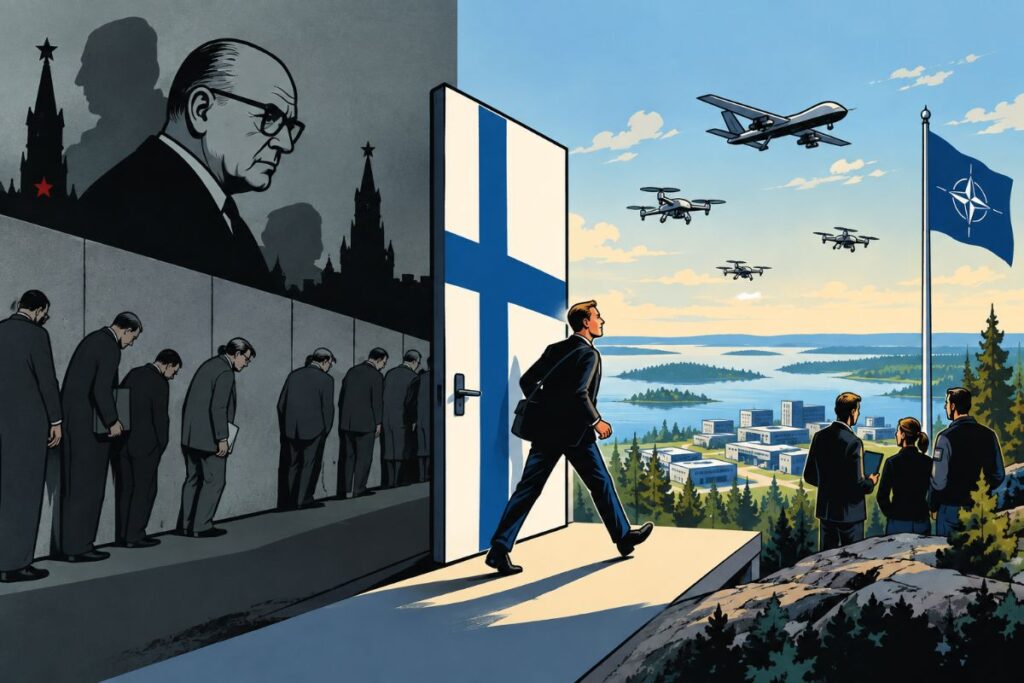
In October, a drone-defense company from Vantaa plans to list on Nasdaq Helsinki at a targeted valuation of €1.3 billion. Its founder has turned down several foreign buyers. Selling abroad, he says, would feel like desertion.
That sentence says more than the valuation. For most of the decades since the war, it would have been an unusual combination in Finland. A founder builds a defense business in the open, raises Finnish pension money for it, and calls Finnish ownership a matter of loyalty. Today it barely makes headlines.
In May, we argued that NATO membership had opened a market Finnish startups had struggled to reach. That was half the story. The bigger change is in what Finland treats as normal. Building, financing and openly celebrating defense technology used to feel politically sensitive, institutionally awkward and, for investors, off limits. Now it is possible, almost ordinary.
The caution had real origins. The 1947 Paris Peace Treaty capped the size of Finland’s armed forces and excluded offensive equipment such as bombers, missiles and submarines. Some of those size limits came from British demands, not only Soviet ones. The following year, the Agreement of Friendship, Cooperation and Mutual Assistance with the Soviet Union, known as the YYA treaty, became the basis of Finnish-Soviet relations until 1992. Moscow used it to gain leverage in Finnish domestic politics, an influence that came to be called Finlandization. How far President Urho Kekkonen, in office from 1956 to 1981, used that pressure for his own ends is still debated.
Finlandization also shaped the press. The historian Hans-Peter Krosby, who studied Finnish-Soviet relations, argued that Finnish self-censorship came more from habit and learned behavior than from direct Soviet pressure. The presidents Paasikivi and Kekkonen were its most visible coaches.
The obvious misread is that Finland was submissive or soft on defense. It was neither. Finland kept conscription and a large trained reserve throughout the Cold War, and the treaty was never read as preventing a large reserve force. The balancing act was also a deliberate Finnish strategy, and it preserved an independent democracy next to a superpower. Finland had a defense industry, much of it state-owned.
The difference was narrower. Nothing prohibited a Finn from founding a defense company. But the political climate, the institutions and eventually the capital markets did not treat defense as an open, investable growth industry. That is what “permission” means here. It was never a law. It was a set of assumptions.
Those assumptions outlived the rules that shaped them. Finland declared most of the treaty’s military restrictions void in 1990, as Germany reunified, keeping only the nuclear weapons ban. The YYA treaty ended in 1992. Staying outside military alliances remained both official policy and a popular choice. As recently as 2017, only 21% of Finns told Yle they supported joining NATO.
Then a newer layer arrived, with a different origin. Across Europe, responsible-investment rules pushed defense to the edge of institutional portfolios. Jussi Hattula, director of industrial investments at the state investor Tesi, has said that five to ten years ago investors treated anything touching weapons or defense like tobacco: something responsible money did not touch. That stigma was not a Soviet legacy. But it compounded the older caution. Finnish defense technology struggled to find both political legitimacy and private capital.
Then all of it moved at once. In February 2022, after Russia’s full-scale invasion of Ukraine, a majority of Finns supported joining NATO for the first time in Yle’s polling. By the end of 2023, more than 80% backed membership.
The investors moved next. The state pension fund VER lifted its prohibition on defense investment in spring 2022, within weeks of the invasion. Ilmarinen, one of Finland’s largest pension insurers, began re-examining its approach the same year. Its previous policy screened out many dual-use companies, those serving both civilian and military customers. Reporting on the change used Iceye as an example of the kind of company such rules can miss: it began by monitoring Arctic conditions and started supplying Ukraine in 2022. Varma, another large pension insurer, updated its principles to allow investment in emerging defense technology. Hattula’s summary: defense has started to interest investors, driven above all by the war in Ukraine and Europe’s push for independence.
Now look at where that capital went. Iceye is an Espoo company that builds and operates radar satellites able to image through darkness, cloud and smoke. In June it raised €450 million at a €10.5 billion valuation, up from €2.4 billion six months earlier. The round was led by General Atlantic, the US growth equity investor. The Finnish investors included Solidium, the state investment company, and Tesi. So did Ilmarinen, Varma, Nokia and Lifeline Ventures, the Finnish venture firm that has backed Iceye from the start.
Sensofusion‘s listing is anchored by Varma, Elo, Ilmarinen and the OP financial group. Two of those four anchors rewrote their responsible-investment rules after 2022 to make room for defense.
That points to the second argument in this story. For strategically important technology, ownership itself can become part of national capability.
After Iceye’s round, the Finnish state holds roughly 12% through Tesi and Solidium, and Finnish institutions about 17% in total. Solidium’s chief executive, Matts Rosenberg, said the aim was a strong Finnish ownership base for the long term. Because Iceye’s customers are governments and armed forces, he argued, a patient state owner helps build trust. Pekka Laurila, Iceye’s co-founder and chief strategy officer, makes a related point about valuation. If Iceye were too cheap, someone could buy it almost by accident.
Tuomas Rasila, Sensofusion’s founder, is even more direct. His customers include Ukrainian army units, the Finnish Defence Forces and the Border Guard. Selling to a foreign buyer would, in his view, betray them. He says the stock exchange is the right place for Sensofusion precisely so it can stay independent and never be sold.
This is not an argument that foreign ownership is bad. Iceye’s round was led by an American investor, and most of the company remains foreign-owned. The point is narrower. In August we wrote that Finland builds well but doesn’t always own what it builds, as Wolt and Supercell showed. A recent ministry report on growth financing flagged shrinking domestic ownership of Finland’s best growth companies as a problem. In defense, a Finnish anchor in ownership is increasingly treated as part of the strategy, not a sentimental preference.
The pattern is European too. Relefy has tracked how Europe tends to lose its breakout companies to American capital at the growth stage. Yet when Helsing, the German defense AI company, closed Europe’s largest defense-startup round in July, it made a point of saying it remains predominantly European-owned.
Here is what the permission story does not mean. Finland did not suddenly acquire engineers or entrepreneurs in 2022. The capabilities were already there. Iceye was founded in 2014 and Sensofusion in 2016, years before the environment turned.
Rasila put about a million euros of his own money into Sensofusion’s early development. When Covid hit, its sales stopped dead and he had to put in more. He let outside investors in only once the company was profitable, which is why he still owns about 82%. Sensofusion’s steepest growth began when the war in Ukraine made governments take counter-drone defense seriously. NATO membership itself was not the trigger.
The numbers followed. HS Visio’s review of Finnish growth companies puts Sensofusion’s 2025 revenue at €35 million, up nearly 88%, with a 66% operating margin. In the first half of 2026, revenue more than doubled to €25.8 million. The same review puts Iceye’s 2025 revenue at €278 million, up 169%. Its order book stands at €1.5 billion, about €1 billion of it from Germany.
Both companies earned their credibility in Ukraine before the large contracts came. Iceye has supplied imagery to Ukrainian intelligence since the start of the full-scale war. Sensofusion has worked with Ukrainian units almost as long. The change in environment opened the door. The work done years earlier decided who was ready to walk through it.
The two headline companies now sit inside a wider sector. A Tesi survey published in August identified 574 Finnish defense companies. Around 200 of them are defense or dual-use startups seeking strong growth, and around 40 are established companies with defense as their core business. Tesi also notes that most Finnish defense companies still earn the bulk of their revenue from other industries.
The same pattern shows up in Europe’s success stories. Tekever, a Portuguese maker of autonomous surveillance drones, was founded in 2001. It became a unicorn in May 2025 on the strength of drones already flying in Ukraine. It is the European reference worth studying: a small home market and decades of building before the money came.
Helsing is the contrast. It was founded only in 2021, and in July it raised $1.8 billion at an $18 billion valuation. Its battlefield record is disputed. Reports in early 2026, based on internal German defense ministry and Ukrainian material, described problems with its HX-2 strike drone in Ukraine. Helsing disputes them and cites confirmed strikes and test results. Capital can now arrive before undisputed proof. Whether the proof catches up is the question procurement officers will ask.
Most of the money still follows proof. Dealroom and the NATO Innovation Fund report that European defense, security and resilience startups raised a record $8.7 billion in 2025, up 55%. Most of that growth came from large late-stage rounds. The environment has opened, but the capital flows mostly to companies that already work.
Don’t overread the Finnish picture either. HS Visio’s review shows the 35 largest Finnish VC-backed growth companies swinging from a €116 million combined operating loss in 2024 to a €183 million profit in 2025. But only 14 of the 35 made a profit, and the turnaround rests on a few locomotives. The market is not frictionless either. In Tesi’s survey, companies named slow procurement as the main brake on growth. Rasila describes defense forces trialling equipment for up to a year before buying more widely.
Earlier this year, a Slush survey we covered found that 56% of Finnish founders who had considered leaving named risk-averse culture as a reason.
It is easy to treat culture as something fixed. Defense suggests otherwise. Assumptions that took decades to form, some of them rooted in the Cold War and some in modern investment norms, gave way in about four years. The polls moved. The pension rules moved. Founders started saying out loud what they are building and why it should stay Finnish. None of that created the companies. It removed what was standing between them and the market.
If a country can unlearn in four years what took decades to learn, what permission are you still waiting for?
Sources
HS Visio (Elina Lappalainen): Sensofusion IPO · Finnish growth company review 2025 · Sensofusion H1 2026 · Iceye €10.5bn round
History: Country Data / Library of Congress country study, treaty commitments · Corporal Frisk, 1990 abrogation · Wikipedia, YYA treaty · Nordicom Review, Finnish press and self-censorship
Public opinion: Yle, March 2022 · Yle, December 2023
Capital: Tesi defense sector survey, August 2026 · Uutissuomalainen/STT via SSS, Jussi Hattula interview · Markets Group, VER · Top1000funds, Ilmarinen · ImpactAlpha, Varma · NATO Innovation Fund / Dealroom, 2025 funding report
Europe: Tekever · Defense News, Helsing Series E · CNBC, Helsing ownership · Tech Times, HX-2 performance dispute
Related Relefy coverage
NATO Changed Finland’s Security. It Also Created a New Market, 4 May 2026 · Finland Builds Well. It Doesn’t Always Own What It Builds, 25 August 2026 [LINK] · The Thing Holding Finnish Founders Back Isn’t “Just” Taxes, 29 April 2026 · Three Continents. Three Priorities. One AI Race, 21 May 2026