
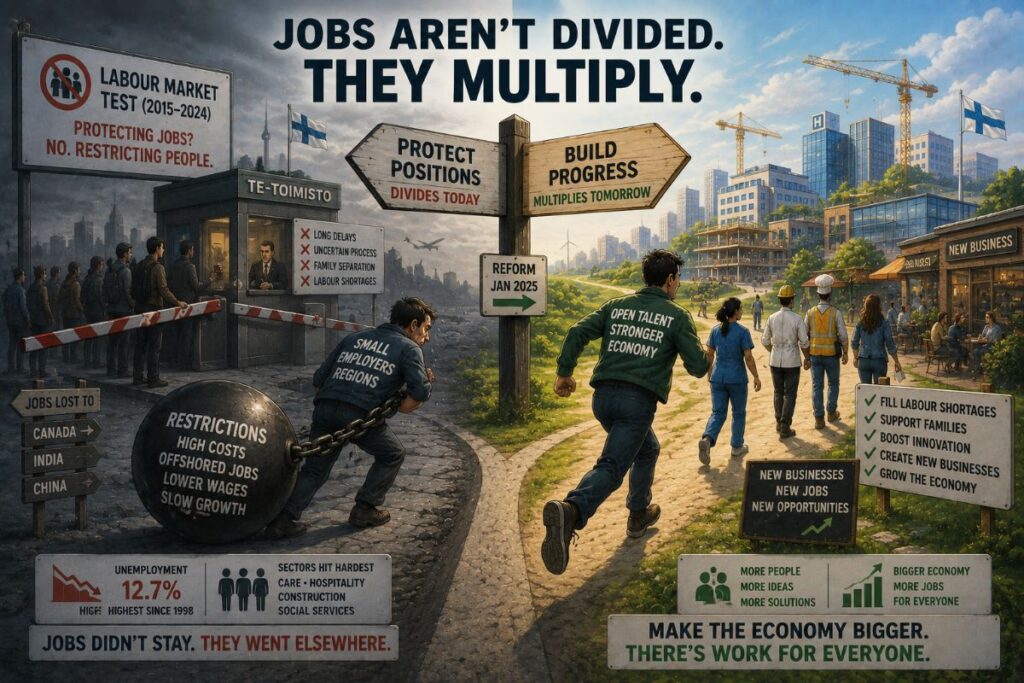
For ten years, Finland required employers to formally prove that no Finnish or EU worker was available before hiring from outside the European Union. The mechanism was designed to protect Finnish jobs.
Finland’s unemployment rate reached 12.7% in May 2026, the highest since 1998.
The mechanism did not protect jobs. It changed where they went.
Finland’s Perussuomalaiset, the True Finns party, are part of the current government coalition. Their immigration position is straightforward: Finns are out of work, foreign workers take those jobs, restriction protects Finnish employment. The logic is clean. It rests on the assumption that the number of jobs in an economy is fixed, and that policy can determine who fills them.
That assumption has a name in economics. It is called the lump of labour fallacy. It has been used to oppose every wave of immigration in recorded economic history. The evidence against it is now specific enough that the more useful question is not whether it is wrong, but what it actually costs when policy is built on it.
What Finland’s system produced
Finland’s regional employment and economic development offices, known as TE-toimistot, administered a formal test before most work permits from outside the EU could be issued. The office first confirmed whether a Finnish or EU worker was available. Only after that partial decision was issued could the Finnish Immigration Service process the full permit application.
In September 2024, Finland’s National Audit Office, an independent state body reporting directly to Parliament, published what that system had actually produced. Standard worker permits for cooks, care assistants, cleaners, and restaurant staff took an average of 68 days in mid-2022, falling to 41 days by early 2024 after improvements. Specialist permits for workers earning above roughly 3,600 euros per month took 8 days. Family reunification for a standard worker’s spouse and children averaged 114 days, against 13 days for a specialist’s family.
Three percent of surveyed companies said the process was easy to predict. A quarter received no information on how their application was progressing.
Finland removed the two-step TE-office process in January 2025 — the Finnish Immigration Service now handles the full application directly. Labour market testing itself continues; what changed was who administers it and how many steps it takes.
What companies did instead
When a company cannot plan around a hiring process, it does not wait. The most rigorous evidence of what happens comes from research on the equivalent US restriction.
The H-1B is the primary visa category through which American companies hire skilled foreign workers. The US government sets an annual cap on new H-1B visas issued to private sector employers. When applications exceed the cap, a lottery decides which are processed. The rest are rejected regardless of the applicant’s qualifications or the employer’s need.
Britta Glennon, a strategy researcher at the Wharton School of the University of Pennsylvania who studies how immigration restrictions shape multinational company decisions, tracked hiring behavior across more than two thousand US multinationals against H-1B visa outcomes over two decades. Her study, published in the academic journal Management Science in 2024, found a clear pattern.
Companies did not hire domestic workers when applications were rejected. For every rejected application, the average multinational created 0.42 jobs outside the United States, primarily in Canada, India, and China. For companies with existing offices across multiple countries, that ratio rose to 0.93. Nearly one foreign job created for every visa rejected. Microsoft opened an office in Canada in 2007 explicitly citing US immigration difficulties. The pattern became systematic.
A restriction designed to keep jobs domestic determined instead which country they moved to. And the companies best positioned to make that move were the large, internationally established ones. Smaller employers without foreign infrastructure absorbed the cost in full.
Who actually paid
That asymmetry ran through Finland’s system in the same way. Specialists on the fast lane received permits in 8 days. Their families joined them in 13 days. Standard workers waited 41 days; their families, 114 days. Finland’s most acute labor shortages, identified in the same audit, were in healthcare, hospitality, construction, and social care: sectors entirely on the slow lane.
The system created the least friction for the workers Finland needed least urgently, and the most friction for the workers it needed most. At company level, it protected multinationals with existing foreign infrastructure while fully exposing smaller regional employers who had nowhere else to place a rejected hire.
How the union argument works against itself
Labour unions are the primary institutional force behind labor market testing, and their reasoning is internally consistent. Limit foreign labor supply and employers face more pressure to raise wages. A test protects domestic workers’ bargaining position.
Finland’s trade union confederation SAK and counterparts across Europe built policy on this logic. The mechanism achieved the opposite.
A 2024 report from the Economic Policy Institute, a US labor economics research organization focused on working-class wages, documented what employer-tied visa systems produce for wages in practice. In the US H-1B program, 60% of certified positions paid below the local average wage for the equivalent occupation. The suppression was structural. When a worker’s visa is tied to a single employer, that employer holds pricing power the worker cannot escape without leaving the country.
Research tracking the US legalization program of 1986, which converted hundreds of thousands of workers with precarious immigration status to full legal residence, measured what changed when that dynamic shifted. Workers who gained portable, employer-independent status saw real wages rise by an average of 15% within five years. Those who completed the path to permanent residence saw total gains of 25 to 32%.
Those gains came from the ability to bargain, to leave, and to move toward better-paying roles. The labor market test produces the opposite conditions: workers who cannot leave without losing the right to remain in the country, which is precisely what employers need to legally pay below market. The mechanism built to protect wages creates the structural conditions for suppressing them.
Jobs are not redistributed. They multiply.
The lump of labour assumption treats immigration as redistribution. Existing jobs get divided differently when new workers arrive. The evidence on immigrant entrepreneurship breaks that model entirely.
Research led by Pierre Azoulay, a professor of management at MIT’s Sloan School, together with economists at Northwestern University, the Wharton School, and the US Census Bureau, analyzed data on more than one million firms founded in the United States between 2005 and 2010. Immigrants were 80% more likely to start a business than native-born Americans and now account for roughly 25% of new employer businesses. Companies with immigrant founders were 35% more likely to obtain a patent. Those businesses hired workers. Those workers bought things. Those purchases generated further employment.
This connects to a mechanism a previous Relefy article made precise. James Bessen, an economist at Boston University whose research was published by the National Bureau of Economic Research, studied what happened in industries that experienced the most dramatic automation in economic history. Employment grew even as productivity exploded, because lower costs unlocked latent demand, and that demand created jobs that did not previously exist. New economic actors do not divide a fixed pool. They expand it. Immigrants function the same way: not as competitors for existing jobs, but as creators of new ones.
Where AI fits
The current argument for restriction goes one step further: with AI automating work across the economy, protecting existing jobs from foreign competition seems more urgent, not less. But a 2026 European Training Foundation review of the full research base on AI’s labor market impact found that aggregate job destruction so far is close to zero. AI is transforming which tasks require human labor within jobs, not eliminating the jobs. The occupations most constrained by Finland’s permit system, care, hospitality, construction, and social services, are defined by physical presence, human judgment, and direct service: precisely what the same research identifies as most resistant to automation.
The assumption underlying the restriction is wrong in every direction you examine it. AI is not shrinking the job pool. Immigrants are not dividing it. The pool expands or contracts based on what the economy does with the people inside it.
What the evidence actually says
The January 2025 reform removed the two-step bottleneck. Processing times will improve. The extra layer driving companies to bypass local hiring altogether and offshore roles to foreign hubs is perhaps not gone, but the direction is right.
The political pressure that created it is building again, in the highest unemployment environment Finland has seen in nearly three decades. The intuition that fewer foreign workers means more jobs for Finns will not disappear because an audit contradicted it.
But the evidence is now documented and specific. For ten years, Finland ran a system designed to protect jobs for Finns. It made those jobs harder to fill, easier to offshore, and cheaper to suppress once filled. It benefited large multinationals and penalized small employers. It harmed the workers it was most loudly designed to protect.
Economies do not protect their workers by deciding who gets to work in them. They protect them by becoming large enough that there is more work for everyone.