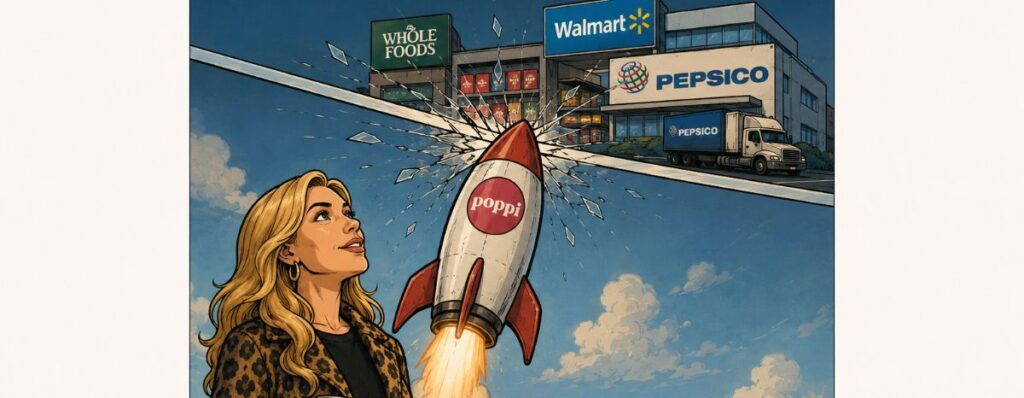
Allison Ellsworth was nine months pregnant, standing in front of Shark Tank investors, when she accepted a $400,000 deal from Rohan Oza. She gave up 25% of the company. But what she actually went to get wasn’t the money.
Years before that moment, she and her husband had been at a farmer’s market in Texas when she told him they needed to go all in. They maxed out their credit cards, sold one of their cars, opened their own manufacturing facility. Within 18 months their prebiotic soda had $500,000 in revenue and a spot on the shelves at Whole Foods.
Then she went on Shark Tank.
Most people think Shark Tank was where Poppi started. It wasn’t. The product already worked. The market had already validated it. What Ellsworth went looking for was not proof that the product was good. She already had that. What she went looking for was the partner who could take it somewhere the product alone could not go.
Oza’s $400,000 didn’t save Poppi. His distribution network did. His connections opened the retailer doors that converted TikTok virality into national shelf space, which eventually justified a Super Bowl ad, which eventually made Poppi impossible for PepsiCo to ignore. And when PepsiCo came calling, Ellsworth said yes for one explicit reason: their distribution system could get Poppi to people she could never reach alone.
The deal closed in May 2025 at a headline price of $1.95 billion — a net purchase price of $1.65 billion after $300 million in anticipated cash tax benefits, plus an additional performance-based earnout (PepsiCo press release).
The $1.95 billion is not the story. The story is that Ellsworth understood, from a farmer’s market in Texas, that a great product has a ceiling. And she spent a decade deliberately finding the partners who could raise it.
Sources: Fortune · Entrepreneur · Food Dive
The Ceiling Problem
Every product has a distribution ceiling. Below it, the product lives or dies on its own momentum. Above it, you need someone else’s infrastructure, relationships, or market access to go further.
Most founders hit the ceiling and wait. They assume that if the product is good enough, the right partner will eventually show up. Sometimes they do. More often, someone else finds the partner first, and the better product loses.
Ellsworth did not wait. She went on Shark Tank specifically to find Oza. She sold to PepsiCo specifically because of what their logistics network could do for her brand. Every major move in Poppi’s history was a deliberate step toward a partner who could break the next ceiling.
That sequencing — product-market fit first, then relentless pursuit of the partner who removes the distribution constraint — is the actual blueprint worth studying.
Finland Keeps Solving the Wrong Problem
Finland invented xylitol chewing gum. In the early 1970s, researchers at the University of Turku discovered that xylitol fights the bacteria causing tooth decay. By 1975, the world’s first xylitol chewing gum had launched. The science was world-class. The product worked. Finnish kindergartens now give it to children after meals as public health policy.
China is now the world’s largest xylitol exporter. The Finnish production know-how was sold to Danish company Danisco. Finland did the research, proved the science, invented the product category, and then watched others build the global business on top of it.
The product was never the problem. The distribution ceiling was never broken.
Lactose-free dairy is the same story. Valio developed the technology. Finland leads the world in lactose-free know-how. The domestic market adopted it fast. But the global market for lactose-free dairy — enormous, given that roughly 65–70% of the world’s population has some degree of lactose malabsorption — is not dominated by Finnish brands. It is dominated by whoever got to the right retailers, in the right markets, first.
The pattern is consistent: Finland solves hard product problems ahead of everyone else. Then it stops. The ceiling never gets broken because no one goes out to find the partner who could break it.
This is not a product problem. Finnish founders know how to build world-class products. It is a distribution problem. And distribution is not solved in a lab or through a Business Finland grant. It is solved by finding the right people and having the right conversations, proactively, in the markets where the demand actually exists.
Sources: Peppersmith · NIH lactose intolerance prevalence
What KONE Understood
KONE was founded in Helsinki in 1910. Finland has no skyscrapers. The domestic market for elevators was never going to make KONE a significant company. The ceiling was visible from day one.
In 1964, Pekka Herlin took over from his father. Unlike his predecessors, he had a background in economics rather than engineering. He looked at the ceiling and made a decision: KONE would go international, with no predecessors among Finnish companies to model the approach on.
The execution was not passive. In 1968 KONE acquired the elevator and escalator business of Sweden’s ASEA — including ASEA’s Norwegian and Danish affiliates — and tripled its business volume overnight. The acquisitions continued without pause: Westinghouse’s entire European elevator and escalator production in 1974, which doubled revenues, followed by companies across Spain, Austria, France, Germany, the UK, Brazil, and the United States.
KONE did not build a better elevator and wait for the world to notice. It went and bought market access, country by country, until it operated across more than 60 of them (KONE history · Wikipedia).
Abloy invented the disc detainer lock in 1907. Genuinely superior security technology. For decades it remained a Finnish company with a Finnish ceiling. The transformation came when Abloy merged with Swedish lock manufacturer ASSA in 1994. The combined entity immediately began acquiring distribution across every major market: Yale in the US, Chubb in the UK, Baodean in China, Irevo in South Korea. Over 300 acquisitions across more than 70 countries. Today Assa Abloy generates over 140 billion Swedish kronor annually. The technology was always there. The global distribution was not, until the right partnership created it (Assa Abloy Wikipedia).
Nokia’s version of the same story is a strategic choice rather than an acquisition. In 1992, Nokia decided to abandon every business line except telecommunications and go all in on a global market. By the mid-2000s it held around 40% of global mobile phone market share — a position it reached through relentless international expansion, not through superior hardware alone. Nokia’s peak share of 38–40% came in 2007–2008, roughly 15 years after the 1992 pivot. The lesson isn’t about speed. It’s about commitment: the decision to stop accepting the ceiling and go find the market where the real demand existed (Wikipedia · InformationWeek).
Three companies. Three different execution paths. The same underlying logic: the product earns you the right to play. Distribution decides what happens after that. And distribution does not come to you.
The Step That Gets Skipped
Finland has Business Finland. It has R&D funding mechanisms that are genuinely world-class. It has one of the highest rates of research investment per capita globally. The infrastructure for building a differentiated product exists and Finnish founders use it well.
What gets skipped is the step between having the product and finding the partner who can take it somewhere. That step does not have a grant attached to it. It requires identifying specific companies and specific people in specific markets, and then going out and initiating the conversation before those people have asked for it.
Ellsworth went on Shark Tank. She didn’t wait for investors to find her farmer’s market stand. Herlin flew to Sweden and bought ASEA. He didn’t wait for a Swedish company to call Helsinki. Abloy didn’t become a global access solutions platform by being excellent at locks. It became one by finding ASSA and deciding that a merger was the move.
The Finnish founder sitting on a world-class functional ingredient, a precision food technology, or a category-defining health product faces the same question Ellsworth faced at that farmer’s market. Not whether the product is good enough. The product is almost certainly good enough. The question is: who has the distribution infrastructure, the retail relationships, or the market access that the product needs — and what would it take to get in front of them?
That question has a concrete answer. Finding it requires going out and looking.
PepsiCo tried to build their own prebiotic soda first. In late 2024 they teased a product called Soulboost — a functional soda with prebiotics, sweetened with juice and stevia. It never reached the market, quietly cancelled when internal signals indicated it wouldn’t succeed. Then they came to Ellsworth instead (BevNet · Food Dive).
They came to her because she had already done everything else right. The product-market fit was real. The brand was built. The retail presence was established. By the time PepsiCo called, Ellsworth had already removed every obstacle except one: global scale. PepsiCo was the answer to that specific problem.
That is the sequence. Product-market fit earns the right to the conversation. Everything after that is about finding the right partner for the right ceiling at the right moment.
The Only Question That Matters
Finland has the R&D. It has the ingredients, the food technology, the precision manufacturing, the scientific credibility. The next functional health category, the next precision ingredient, the next product that the global wellness market does not yet know it needs, is more likely to come from here than from most places on earth.
Whether it becomes a Finnish success story or just another Finnish invention that someone else scales depends entirely on one thing.
Who goes out and finds the partner?
What’s the ceiling your product has already hit — and who in the world has the infrastructure to break it?