Finland punches above its weight in almost every metric that should produce world-class companies. It consistently ranks among the top nations globally in education, research investment, and digital infrastructure. It produced Nokia, which briefly owned the mobile phone market. It produces engineers, designers, and founders at a rate that larger countries envy.
And yet Finland is routinely criticised for thinking small. For building companies good enough to sell, not big enough to dominate. For stopping at the point where ambition would require believing the impossible is possible.
Lari Lehto, 27, from Hämeenlinna, is not interested in that ceiling.
His company OfferSwap is is challenging LinkedIns datamodels — a platform owned by Microsoft, generating nearly $18 billion in annual revenue, with over a billion professional profiles and the dominant position in B2B data globally. When asked whether that sounds realistic for a startup from Finland, Lehto did not entertain the premise. He does not accept the limiting beliefs others impose on what is possible — or who is allowed to try.
What LinkedIn gets wrong
Lehto has used LinkedIn for eight years. He knows the platform well enough to know exactly where it fails.
In our conversation, we discussed LinkedIn’s relationship with its users as a form of structural arrogance — the kind only a dominant platform can sustain. Since 2015, LinkedIn has progressively tightened its API access to drive users toward premium offerings like Sales Navigator. The practical result: professionals cannot export their own connections — the data stays in LinkedIn. An entire industry of workaround software exists for the sole purpose of moving data that users generated, out of a platform that treats it as its own property.
But the deeper problem is the data model itself.
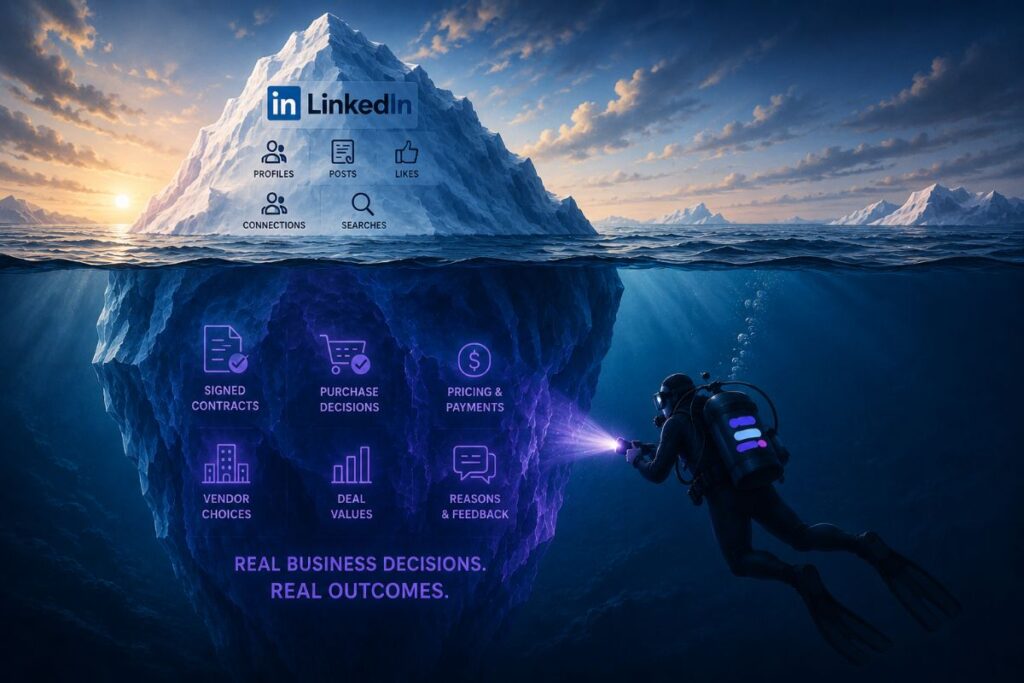
LinkedIn generated $17.81 billion in revenue in fiscal year 2025, with advertising alone projected to reach $9.7 billion in 2026. That revenue is built on one mechanism: selling inferred intent to B2B marketers. LinkedIn knows your job title, your connections, your content habits.
It does not know what you actually bought. Which accounting firm you signed with. Which ERP system your company chose, at what price, or why you switched. Meta, with $200 billion in 2025 revenue, has the same blind spot in B2B — its Marketplace is overwhelmingly consumer. The outcome of every procurement decision you have ever made is invisible to both of them.
“Contract data — you simply cannot get it anywhere,” Lehto said. “That is what we are building.”
Two layers of data nobody else has
Most people who encounter OfferSwap see a service marketplace: a mobile-first platform where consumers and businesses compare, request, and purchase services across dozens of categories, with a community layer on top.
That is the visible product. The data layer underneath is what Lehto calls the real business.
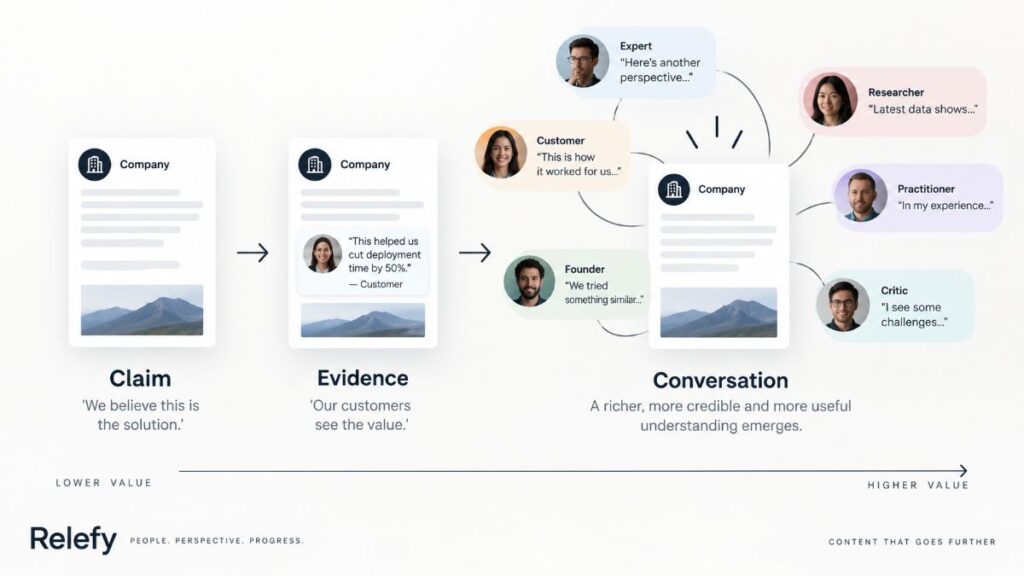
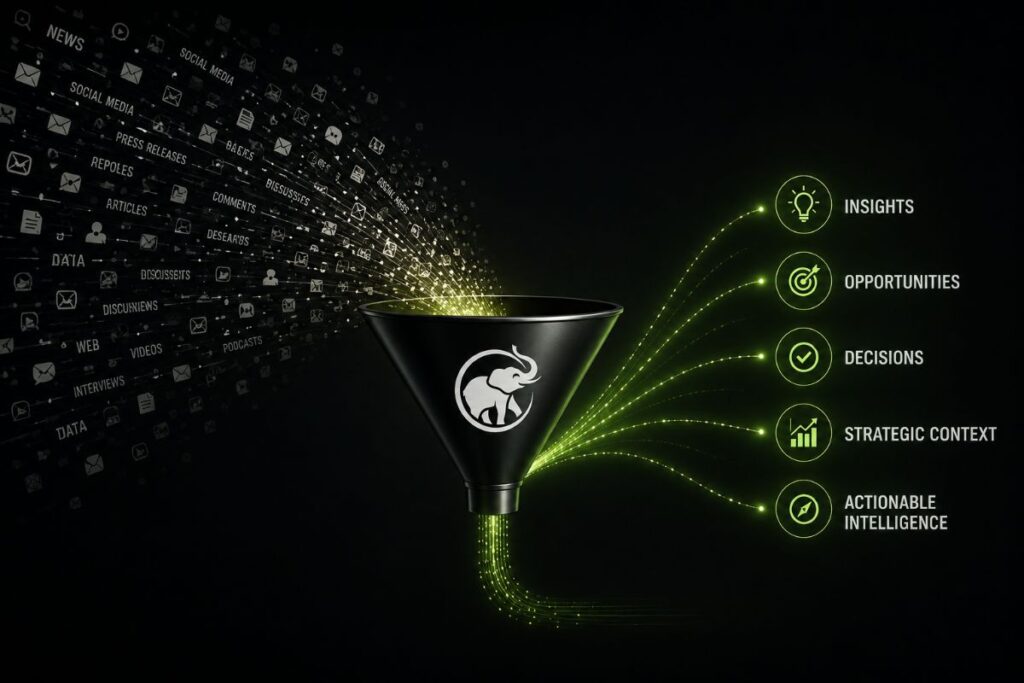
It has two distinct parts. The first is survey-based: users answer questions about what they purchased, from whom, at what price, and why they switched. Consent-based and self-reported — but structurally different from the behavioural signals that companies like 6sense built a $5.2 billion valuation on top of. Those signals tell you what someone might be thinking. OfferSwap’s tell you what they said they decided.
The second layer is more valuable: actual transaction data from the marketplace itself. When a business selects a provider, agrees a price, and closes a deal on OfferSwap, that event is recorded directly. Not inferred. Not scraped. It happened on the platform.
Lehto is candid about the gap between the two. “The survey tells you what someone remembers. The transaction tells you what they did.” Users who upload a contract or screenshot confirming a completed decision produce a data point worth significantly more than an unverified answer.
The funnel no one can see
The B2B buying process has moved somewhere that LinkedIn’s trackers cannot follow. Gartner finds that 61% of B2B buyers now prefer a rep-free experience, evaluating through private channels — AI tools, closed Slack communities, peer networks — that traditional tracking cannot reach. Forrester consistently places 70 to 80 percent of the B2B evaluation process before first vendor contact.
The intent platforms sell signals from the open web. The decisions are increasingly happening off it.
OfferSwap does not compete in the research phase. It captures the moment after the decision — on its own platform, with the buyer’s active participation. Where the buyer did their research is irrelevant. The outcome is what it records.
Why scale becomes a trap
Andreessen Horowitz documented the pattern: horizontal platforms become victims of their own success. The product gets pulled in every direction. High-value users disengage. Craigslist was unbundled by Airbnb, Tinder, and Reddit — none of which tried to replace it. They just did one thing better.
LinkedIn is showing the same symptoms. Its feed has become indistinguishable from any other social platform. B2B contact data decays at 22 to 30 percent per year because users have no financial reason to keep their profiles accurate. And structurally, LinkedIn cannot fix this — a compensation model would immediately cannibalise the advertising margins that generate its $17 billion in revenue.
That is the opening. Not a better LinkedIn. A different game entirely.
The model — and the honest risks
The global data broker market was worth approximately $331 billion in 2025. ZoomInfo generated over $1.2 billion in 2024 revenue from data collected without compensating the people it describes. OfferSwap’s model flips this: users receive a revenue share every time their data sells — not once, but every transaction. “If your data is worth four euros, you get one euro every time a buyer purchases it,” Lehto explained.
Since GDPR came into force, regulators have issued over €5.88 billion in cumulative fines. LinkedIn itself was fined €310 million in October 2024. The platforms paid and continued. GDPR gave individuals the right to say no. It did not give them a reason to say yes on their own terms. A revenue share does what regulation could not.
The model is compelling in theory. The challenges are structural.
The first is the classic marketplace cold-start problem. OfferSwap needs enough verified transaction data to attract serious buyers — AI labs, enterprise research teams, sector specialists — but those buyers won’t commit until the data is there. The company raised €2 million in early 2026 and attracted over 20,000 users and 6,000 businesses in beta, generating more than €2 million in revenue for service providers. That proves the marketplace works. It does not yet prove the data business does.
The second is verification at scale. Asking users to upload contracts and screenshots works for early adopters motivated by novelty. Whether it works at the volume needed to build a meaningful data product is unproven. Data quality is only as good as user participation — and participation requires ongoing trust that the platform will continue paying fairly and handling data responsibly.
The third is network effects working against the challenger. LinkedIn’s moat is not just its data — it is the fact that every professional already has a profile there. OfferSwap is not asking people to update a profile. It is asking them to change where they find and transact with service providers. That is a harder behaviour to shift.
There are an estimated 5,000 data brokers globally. Almost none pay the people generating the data. That is a real gap. Whether a two-year-old Finnish startup is the one to close it at scale is a different question.
Finland, and the ceiling that does not exist
“There is a mentality here — a ceiling that nobody drew but everyone respects,” Lehto said. “You are not supposed to earn too much, grow too fast, want too much. And then you wonder why so few build anything that matters globally.”
His response was not to complain. He made cold calls to the United States. Within days he had conversations that would have taken months in Helsinki. “In America, people think bigger by default. You say you are taking on LinkedIn and they ask how. Here, they say it is impossible.”
Lehto spent two months in Silicon Valley exploring the market. The US is where the demand-side buyers are most likely to come from first — and where the ambition required to chase them is treated as normal rather than suspicious.
The question
The platforms that own your professional identity built empires on the gap between what you signal and what you decide. That gap has been worth hundreds of billions of dollars — to them.
The next shift in B2B data will not come from a better algorithm inferring intent from your browsing history. It will come from someone who figured out how to make you want to share what you actually did.
Whether that someone is a 27-year-old from Hämeenlinna — or whether this is another Finnish company that gets acquired before it gets big — depends on a question that has not yet been answered at scale: not whether the model is right, but whether enough people will show up to make it real.