
Janne Neuvonen, founder and CEO of BCaster, a Helsinki company that helps brands collect and legally manage the photos and video their own customers create, didn’t set out to build a company around user-generated content. He built one because in 2015 he was standing next to a crashed rally car in the Finnish woods, watching TV crews scramble for footage that only the bystanders actually had. Nobody at the scene of a crash is thinking about brand messaging. That’s exactly why the footage worked: the people standing there possessed evidence of something that had actually happened, and nobody else did.
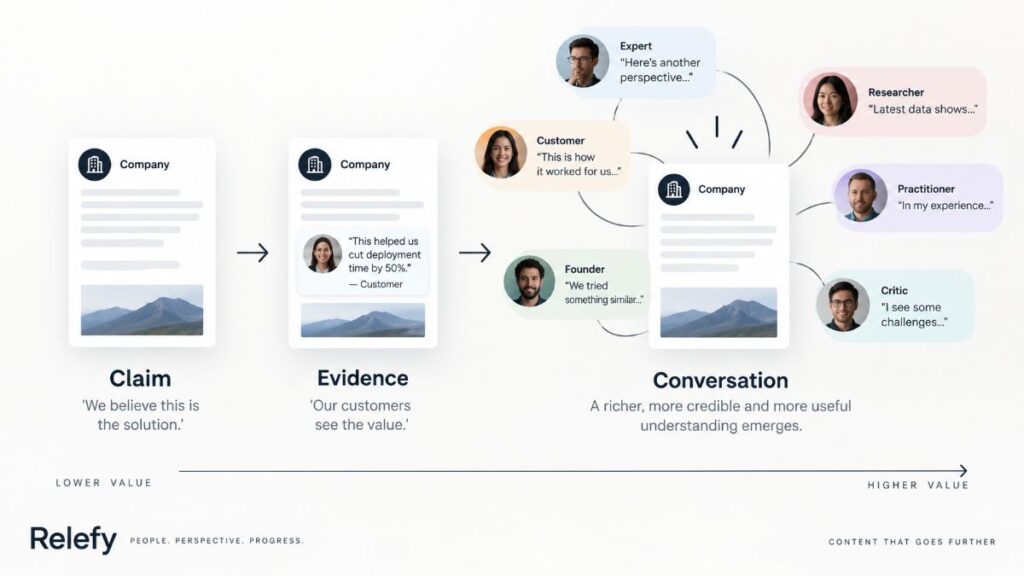
Call that an authenticity story and you’ll build the wrong fix. The obvious reading is that customers believe other customers because customers are “real” and brands are not, so the answer is to make brand content look rawer: staged messiness, curated phone footage, the aesthetics of authenticity without the substance behind it. That’s still generic. The actual distinction was never polished versus unpolished. It’s claim versus evidence, and eventually generic evidence versus relevant evidence. We’ve made a related case before, that what looks like an authenticity crisis in content is usually a relevance crisis wearing an authenticity costume.
A brand can say almost anything about itself. “Built for demanding conditions.” “Trusted by professionals.” None of it can be checked in the moment a reader encounters it, so none of it moves anyone who wasn’t already convinced. A story from someone in a similar situation lands as evidence. A brand saying the same thing about itself lands as a claim. Evidence and claim can use the exact same words. What separates them is whether the person saying it had any way to fabricate what they’re describing.
There’s research behind why some evidence lands harder than other evidence, and it isn’t authenticity either. It’s homophily: people trust people who resemble them more than they trust people who don’t. A 2024 Harvard Business Review study led by Wharton’s Zhenling Jiang, with Rachel Gershon, Will Fraser, and Jitendra Gupta, analysed 41 million customers of a cash-back app and found that people who joined through a referral went on to refer 30 to 57 percent more new customers than people who joined any other way. The mechanism they name is homophily itself: people build social networks out of others similar to themselves, so a referral from someone like you signals that the next person in that network is like you too.
That’s the detail that gets lost when people talk about UGC as one category. A random customer photo proves somebody used the product. It answers the weakest possible question. A customer who resembles the person looking at it, who’s using the product in a situation they recognize, or who had the exact problem they have, answers a far more commercially useful one: does this work for someone like me? Most of the value sitting inside a brand’s customer content isn’t UGC in general. It’s the fraction of it that happens to match a specific viewer to a specific context.
Consider the outdoor brand Canada Goose. Their marketing department could have written “built for demanding conditions” in an afternoon, the way any outerwear brand can. What it actually has is a different kind of proof. According to accounts of the brand’s early years, its first real customers weren’t models or celebrities. They were mountain climbers, Arctic expedition members, dogsledders, and heli-skiers, people who bought the jacket because they needed it to survive a specific place, and the brand’s early growth ran largely on their word of mouth rather than on advertising. Each one of those buyers, telling the same story to their own network, was a separate piece of contextual evidence that no studio shoot could have staged as convincingly, because no production budget substitutes for someone who actually needed the jacket to not freeze. The company appears to have kept leaning on the same logic since, favoring real expeditions and genuinely harsh environments over celebrity endorsement as its way of proving the product works. A slogan says the jacket survives demanding conditions. A climber who actually wore it at altitude is the reason anyone believes the slogan.
Neuvonen’s own view is that this content works on emotion before it works on logic. People recognize a real experience the moment they see one, the same way they recognize a manufactured one, and that recognition is what creates identification. He also thinks brands routinely dismiss customer material for looking messy or unprofessional, when the lack of polish is often exactly what signals it wasn’t staged. He puts the tradeoff to founders as a rhetorical question rather than a measured result: does it matter whether it’s a ten-thousand-euro agency brochure that generates ten thousand euros in sales, or a thousand euros of material collected from customers that generates a hundred thousand? Nobody has run that experiment cleanly enough to cite as data. But the question makes a defensible point on its own: the more expensive version isn’t automatically the more persuasive one, and spending more on production doesn’t buy you out of the evidence problem.
AI sharpens this rather than resolving it. A company can now produce unlimited beautiful product photography, video, and copy, in any setting it can describe. What it still cannot do is retroactively manufacture the fact that a real person used the product, in a real place, and had a real experience worth showing. AI can create infinite content. It cannot create a customer. Whether that scarcity becomes more valuable as manufactured content gets cheaper is a reasonable bet rather than a proven one; nothing cited here tests that directly. But the logic holds regardless of how the market prices it yet: if content is abundant and evidence of real use is not, the second becomes the rarer asset.
Most brands already have more of that evidence than they realize, scattered across social platforms, review sites, and inboxes, largely unused. The problem stops being creative and turns operational: how do you find it, know what’s actually shown in thousands of photos and videos, identify which contexts are worth using, get the rights to use them legally, and make any of it searchable later. That’s the specific gap Neuvonen built BCaster to close: a platform for brands to collect, rights-manage, and make sense of customer-generated photos and video, including what an AI layer can extract about where and how a product actually gets used. It’s less a media company than infrastructure for something a brand already owns and mostly can’t see.
The question isn’t whether your next piece of content looks authentic. It’s whether the person you’re trying to convince can see someone like them, in a situation they recognize, proving the thing you’re asking them to believe.
Sources
Gershon, R., Jiang, Z., Fraser, W., & Gupta, J. (2024). Research: Customer Referrals Are Contagious. Harvard Business Review.
Relefy Media, “The Real Scarcity Isn’t Authentic or High-Quality Content. It’s Relevance.”
BCaster company background, interview material from Janne Neuvonen, Founder & CEO, BCaster.
Indigo9 Digital, “The Keys to Canada Goose’s Success.”
The Brand Hopper, “Marketing Strategies and Marketing Mix of Canada Goose.”