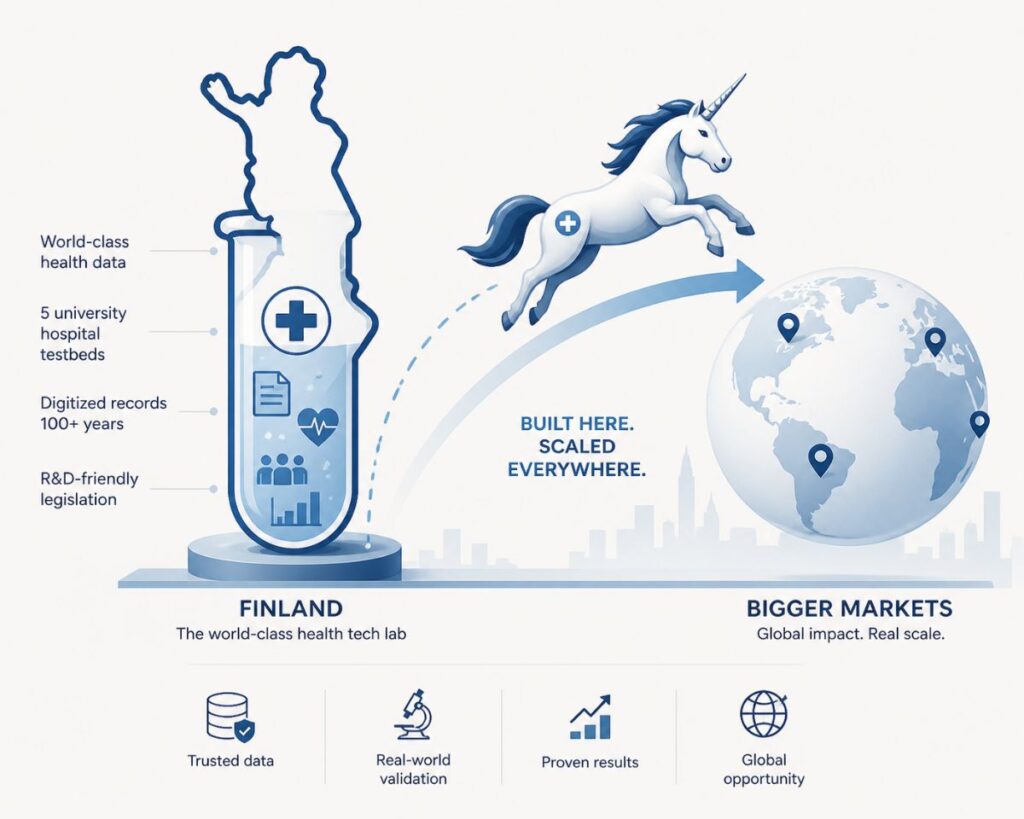
Finland has world-class health data, five university hospital testbeds, a digitized patient record system built over a century, and legislation that lets companies use anonymized population-level data for R&D. On paper, it’s one of the best environments in the world to build health tech.
Selling into it is a completely different story.
The gap between those two things is exactly where the opportunity lives — for the builders willing to understand what they’re actually navigating.
The system is under genuine pressure
Finland’s government has committed to cutting back obligations across the 21 wellbeing services counties responsible for healthcare, with the explicit aim of curbing cost growth. The government is targeting €170 million in savings across the social and healthcare system, with measures including lower staffing requirements and replacing some elderly home care with digital tools. Startup100EU-terveydenhoito
The political framing is “efficiency through digitalisation.” The operational reality: the system needs to do more with less, and it cannot build the tools itself fast enough.
That’s not a threat to health tech startups. That’s a brief.
But there’s a wall — and it’s ideological, not bureaucratic
Here’s what most outsiders underestimate.
The major political faultline in Finnish healthcare is between privatisation and the public organisation of services. This isn’t inertia. It’s a deeply held belief — across parties, across generations — that healthcare is a public good, and private sector involvement is a threat to equity, not a solution to efficiency. Finnishhumanrights
The practical consequence for builders: even when a county procurement officer wants your product, the political layer above them may block or slow it — not because the solution doesn’t work, but because of what it represents. The customer and the decision maker are often not the same person.
This is why framing matters more than product in Finland. The same solution gets a completely different reception depending on whether it’s positioned as infrastructure that helps the public system perform better, or as a private alternative to a public service. Companies that navigate this well make the public system the hero. Not “we replace what doesn’t work.” But “we help what works, work better.”
The data advantage is real — and some companies are already using it
Finland’s national Kanta platform has provided secure, seamless health data access for over a decade, and the Secondary Use of Health Data Act has positioned Finland as a premier destination for pharmaceutical R&D and clinical trials — enabling rapid identification of patient cohorts and generation of real-world evidence that most countries simply cannot match. Valto
The companies already building on this:
Oura validated its sleep and health tracking technology against Finnish population data before scaling to a global consumer product now worn by millions. The ring didn’t become credible because of marketing — it became credible because the underlying data was exceptional.
Aiforia built AI-powered pathology image analysis using Finnish clinical data, and now sells to hospitals and research institutions across Europe and the US. The product was developed here. The market is elsewhere.
Algorithmiq, working at the intersection of quantum computing and drug discovery, partnered with NVIDIA in 2025 to tackle quantum error mitigation for real-world healthcare applications — built in Helsinki, aimed at global pharma. Finnish Government
Finnish deep tech companies set a funding record in 2025, raising nearly €1.6 billion — a 170% increase over 2024. Health tech exports to the US alone reached €856 million. This is not a market in its infancy. It is a market that has quietly figured out the model. Valto
The path of least resistance — and it’s already the playbook
The companies winning here are not trying to disrupt Finnish healthcare. They are using Finland as a laboratory and the world as a market.
The logic is straightforward. Use Finnish data — century-long, digitized, population-level, legally accessible — to develop and validate. Use Finnish university hospitals as real-world testbeds. Then take the validated product to the US, Germany, Japan, or wherever the buying environment is less politically complex and the market is large enough to build a real company on.
Business Finland’s AMPlify program is now explicitly built around this model — connecting Finnish health tech companies directly to the Mayo Clinic and US market entry, resulting in seven term sheet offers from the first cohort of twelve companies. This isn’t accidental. It’s the government-backed acknowledgment that Finland produces the innovation and the world buys it. Wiley Online Library
The consensus from Business Finland is direct: the Finnish system works as a first testbed, but companies must go global to grow. WHO
What the global unicorn data signals
Six healthcare unicorns in Q1 2026 alone — Pomelo Care, Midi Health, Garner, Iterative Health, Solace, Talkiatry. None of them built breakthrough science. All of them fixed broken access and navigation problems inside existing systems. They didn’t wait for reform. They built what the system couldn’t build itself, and they scaled it globally.
Finland has the ingredients to produce exactly that kind of company. The data. The research infrastructure. The engineering talent. A system under enough pressure to need new tools.
What it doesn’t have is a straightforward path to selling at home. Which means the next Finnish health tech unicorn won’t be built by fighting that reality — it’ll be built by someone who accepted it early, validated here, and went global before the domestic market had time to say no.
The question worth sitting with
Finland’s health data is a genuine global asset. A century of population-level records, accessible by law, validated in world-class clinical environments. Most countries building health tech would trade a lot for that starting position.
The builders who use it wisely won’t be selling healthcare services in Tampere. They’ll be selling validated, data-backed products in Boston, Berlin, and Tokyo — with a Finnish proof point that nobody else can replicate.
What problem do you know well enough to build that way?