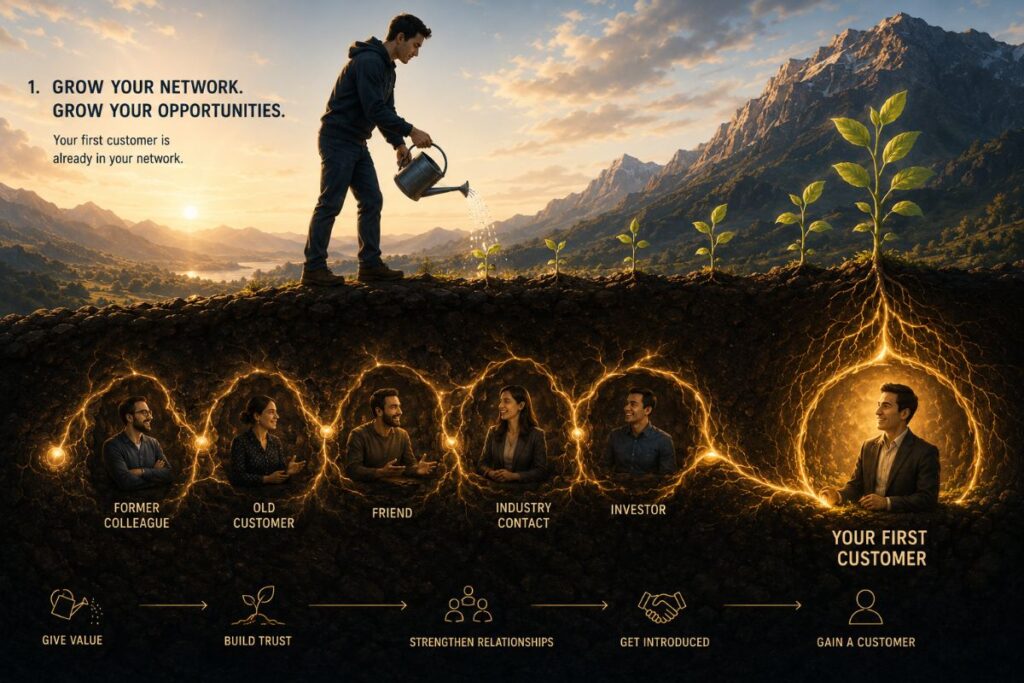
Every founder remembers their first customer.
Not because of the revenue. Because of what it took to get there.
Airbnb’s founders didn’t launch a platform and wait. They personally photographed apartments to make listings look good enough to rent. Unscalable. Uncomfortable. Completely necessary. As Y Combinator documented, the listings improved, conversions improved, and the founders had conversations with customers they could not have had any other way.
The Brex founders personally onboarded their earliest customers. The SERP Forge team wrote cold emails so personalized they referenced each prospect’s individual challenges, then followed up repeatedly — each time adding new value rather than just checking in. According to HubSpot’s customer acquisition research, over 60% of SERP Forge’s early deals came from those follow-ups.
Y Combinator has been telling founders the same thing for over a decade: get your first customer by any means necessary. Do things that don’t scale. Show up in ways that a system never could.
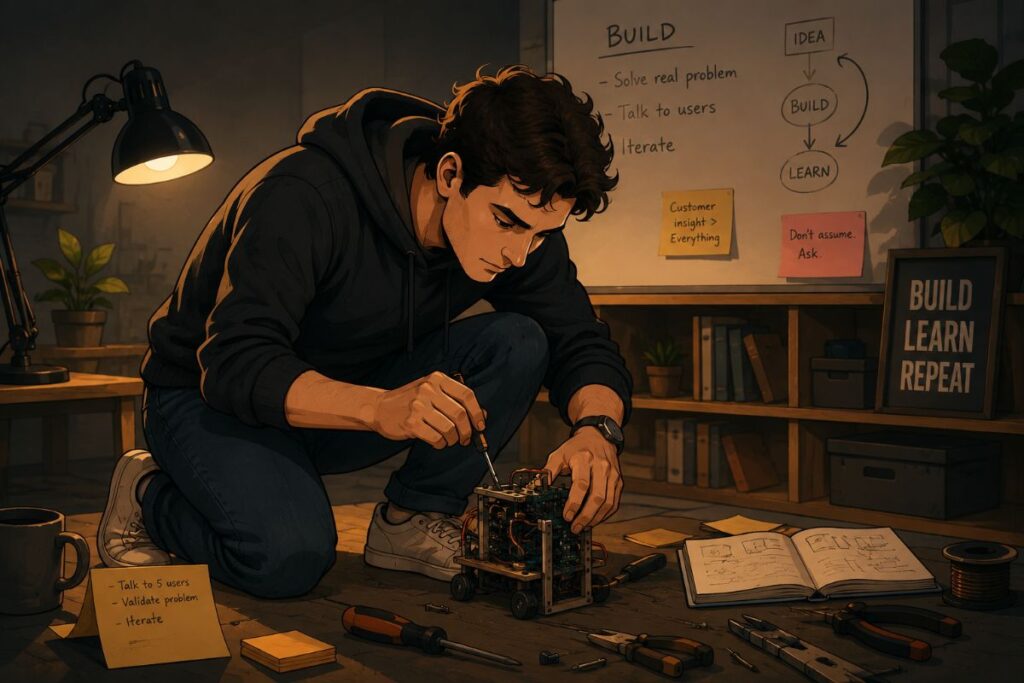
The pattern is consistent enough to be a rule. The manual grind is not a phase to survive. It is the education.
So what happens when founders start skipping it?
What AI Has Changed
AI can now write a cold email in seconds. It can identify your ideal customer profile, build a prospect list, personalize outreach at scale, and follow up automatically. A founder in 2025 can reach ten thousand potential customers before ever having a real conversation with one.
This is genuinely useful. It removes friction that used to slow early traction. It lets small teams punch above their weight in outreach volume.
But it also introduces a risk that is easy to miss: the founder who automates their way to a first customer may have closed a deal without ever learning anything.
Some companies appear to show that the path to early customers can look very different from the traditional manual grind. Midjourney grew through Discord without a sales team. Notion spread through word of mouth before it had a formal go-to-market motion. But these are not evidence that the manual phase can simply be skipped. As NYU Stern’s research on initial target customers notes, Notion’s early growth was the result of a deliberate, focused strategy targeting tech-savvy early adopters — not an accident of virality. In both cases, the founders had spent years building deep domain expertise before the product launched. The manual work happened earlier. It just looked different.
These are not the norm. And they are not an argument for automation before understanding.
What the Manual Phase Actually Teaches
The first customer conversation is not primarily a sales event. It is a diagnostic.
When a founder sits across from a prospect — physically or on a call — and tries to convince them to pay for something that barely exists, they learn things no AI-generated summary can produce: which words make the prospect lean in and which make them look away; what they actually care about versus what they say they care about; what the real objection is under the surface-level no; whether the problem being solved is painful enough to open a budget, or merely interesting enough to agree to a demo.
Paul Graham describes this as the difference between what users say and what they do. You cannot close that gap with automated outreach. You close it by being in the room.
Y Combinator’s position on this, from their Startup School session on getting first customers, is direct: the reason to do things that don’t scale is not efficiency. It is learning. And it is only after that learning is embedded in the founder that scaling makes sense.
The founder who skips this phase builds their go-to-market strategy on assumptions. Some will be right. Many will not. The expensive part is not finding out they were wrong. It is finding out late.
What Skipping It Actually Looks Like
The clearest documented example is not an AI-native startup. It is Quibi.
Jeffrey Katzenberg and Meg Whitman raised nearly $1.75 billion before launch and built a full content platform around a single assumption: that people wanted to pay for premium short-form video on their phones during commutes. They never ran small-scale experiments with real users to test it. As Startupik’s post-mortem documents, there was no small-scale beta, no controlled test, no willingness to validate the thesis cheaply before committing. They built a $1.75 billion machine around a consumption behavior that had not been validated. The company shut down six months after launch.
The mechanism was money and prestige rather than AI automation. But the error was identical: scale before understanding. Assumptions substituted for conversations. Activity metrics — in their case, downloads and content volume — substituted for real signal.
The AI-native version of this mistake is newer, and the post-mortems haven’t been written yet. But the structure of the failure is the same. Startup Genome research found that 45% of startups that scale prematurely spend more than $15,000 per month on acquisition before optimizing their funnel — while 80% of the startups that survive simply don’t spend that much earlier. Spending that precedes understanding is not traction. It is noise with a budget.
The New Version of the Mistake
Founders have always been tempted to avoid the discomfort of early sales. The old version was building the product endlessly instead of launching it. Waiting until it was ready. Hiding behind roadmaps.
The new version is automating outreach before understanding what to say. Scaling a message that has never been tested in a real conversation. Letting AI handle the part of the process that was supposed to be uncomfortable — precisely because the discomfort was the point.
The result looks productive. Open rates, reply rates, booked demos. Activity metrics that feel like traction. But if the founder cannot sit down with a customer and hold a conversation about why they bought, what they expected, and what they would tell a colleague about the product, the numbers are noise.
In a study of 83 failed startups by Failory, the most common answer to “what would you do differently” was: talk to customers and validate assumptions before writing a single line of code. The founders who failed knew the answer in retrospect. The ones who are automating outreach in year one may not find out until it is too late to course-correct cheaply.
Charging from the first sale matters for the same reason. As Y Combinator’s Startup School makes explicit: a customer who pays has made a decision. A customer who signs up for free has not. Free users validate interest. Paying customers validate a business. The willingness to pay is one of the most important signals in early sales, and you lose it the moment you make paying optional.
What Has Not Changed
The underlying logic is unchanged. Before you can build a repeatable sales process, you need to know what works. Before you know what works, you need to have done it manually enough times to see the pattern.
AI accelerates everything after that point. It is genuinely powerful at scale. But it cannot generate the insight that comes from doing the work yourself first.
The founders who will use AI well in their go-to-market are the ones who did the manual work first. They know what a good conversation feels like. They know which objections are real and which are reflexes. They know which customer profiles close and which ones drain time without converting.
That knowledge did not come from a language model. It came from the dozens of conversations that felt like failure before the first one that felt like a breakthrough.
The Question Worth Asking
Before you hand the first customer conversation to a tool, ask: what would I lose by not doing this myself?
If the answer is nothing, your product may already have product-market fit strong enough that distribution is the only problem. In that case, scale.
If the answer is something, do it yourself first. Not because it is the efficient path. Because the inefficiency is where you learn what you need to know to build something worth scaling.
If the Airbnb founders were still personally photographing apartments in year one — what are you automating right now that you should still be doing yourself?