Whose Plan Is It, Anyway? argued that the academic literature on business planning was really studying ventures with a gatekeeper standing between them and their money, a bank, a VC, a grant office, and that the document existed to satisfy that gatekeeper rather than prove anything to a customer. The obvious next question is what happens when the gatekeeper stops asking for the document at all. April 2026 gave a clean example, and the honest answer turns out to be more interesting than “proof got skipped.”
28 new unicorns joined the Crunchbase Unicorn Board that month, 26 of them AI companies. Two entries came from the same starting point: former DeepMind researchers, both based in London. Ineffable Intelligence, founded by David Silver, the researcher behind AlphaGo, hit a $5.1 billion valuation on a $1.1 billion seed round. Recursive Superintelligence, founded by former DeepMind principal scientist Tim Rocktäschel, hit $4.5 billion on a $500 million round. Neither company had shipped a product, generated revenue, or published a roadmap.
That’s not evidence either team skipped market conversations entirely. Researchers raising at this level have almost certainly talked to potential enterprise customers, research partners, and collaborators long before any term sheet got signed. What’s actually missing isn’t market contact, it’s market proof: a shipped product responding to a real transaction, the kind of signal Caroline Lynch got the moment someone bought one of her necklaces. That distinction matters more than it first appears.
Two different questions, mistaken for one
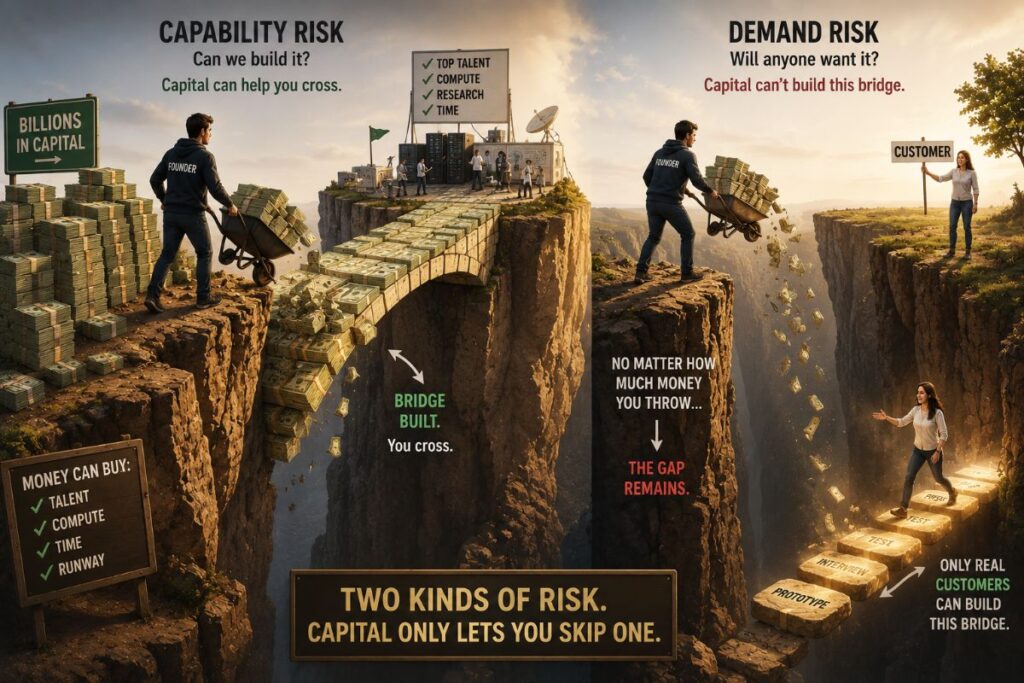
Steve Blank’s Customer Development framework, the one How to Build a Great Company, Step by Step lays out, exists to answer a specific question: does this solve a real problem that someone will actually pay for. Call that demand risk. It’s the dominant uncertainty for nearly every founder story in the Entrepreneur Media dataset, and for nearly every bootstrapped business behind the 86,000 net new businesses Finland added since 2022. Nobody knows if the market wants the thing until a real customer responds to it. No résumé fixes that. A brilliant team can build the wrong thing beautifully and still fail.
Ineffable Intelligence and Recursive Superintelligence are answering a different question entirely. Their uncertainty is capability risk: can this specific team, attempting reinforcement learning at a scale nobody has reached, actually pull off the technical breakthrough it’s betting on. There’s no customer who can validate whether AGI-grade reinforcement learning works, because that’s a scientific question, not a market one. There may well have been plenty of conversations with potential enterprise customers about what they’d want if the science succeeds. None of those conversations can resolve the actual open question, which is whether the science succeeds at all.
So when Silver gets funded on the strength of having built AlphaGo, that’s not “team beats customer.” It’s an efficient, legitimate signal for the only question currently answerable: has this person solved problems of this exact shape and difficulty before. Kirsch et al.’s finding from the first piece, that VC decisions were largely intuitive and the plan’s role was ceremonial, applies just as well here. The investors aren’t skipping evaluation. They’re evaluating the thing that’s actually evaluable.
What the funding concentration is really showing
Crunchbase’s funding data from May 2026 showing 80% of new U.S. venture capital flowing into rounds of $500 million or more, across just 29 companies, isn’t evidence that proof has stopped mattering at scale. It’s evidence that capital concentrates around ventures where capability risk dominates and the underlying bet needs years of runway before any market test is even possible. That’s an expensive kind of patience, and very few balance sheets can afford to extend it. Rounds between $1 million and $10 million, the tier where demand-risk validation actually happens, were down over the same period, a separate trend worth watching on its own, but not evidence that the rules changed for everyone.
Where the actual risk sits, for nearly everyone reading this
Almost no founder building a SaaS product, a services business, or a consumer brand is carrying capability risk in the Ineffable Intelligence sense. The science isn’t the open question. Whether anyone wants what’s being built is. For that founder, a strong team is not a substitute for a customer’s answer, no matter how good the résumé. Blank’s instruction, get out of the building, applies to them with full force, because the building is genuinely where the unknown lives.
The misread to avoid
This isn’t a case for assuming a great team can always defer testing, and it isn’t a case against backing exceptional researchers on reputation either. Both are mistakes, just in opposite directions: a demand-risk venture treating its team’s pedigree as proof of market fit, or a genuine capability-risk venture wasting time on customer interviews before the underlying technical question has any answer to test against. The asymmetry between a $5 billion seed round and a bootstrapped founder testing an idea on Etsy isn’t unfair. It’s a mismatch of risk type to method, and conflating the two is the actual mistake worth naming.
Before deciding what kind of proof a venture needs, the harder and more useful question comes first: which risk does it actually carry, and is the evidence being collected the kind that risk can even be settled by?