
Most entrepreneurs work too hard on the wrong things. Not because they are lazy or undisciplined. Because they were trained, for years before they ever started a business, to confuse activity with progress.
That training is invisible. It feels like work ethic. It feels like discipline. And it is quietly destroying more businesses than any market downturn or funding shortage ever could.
The system that built your habits
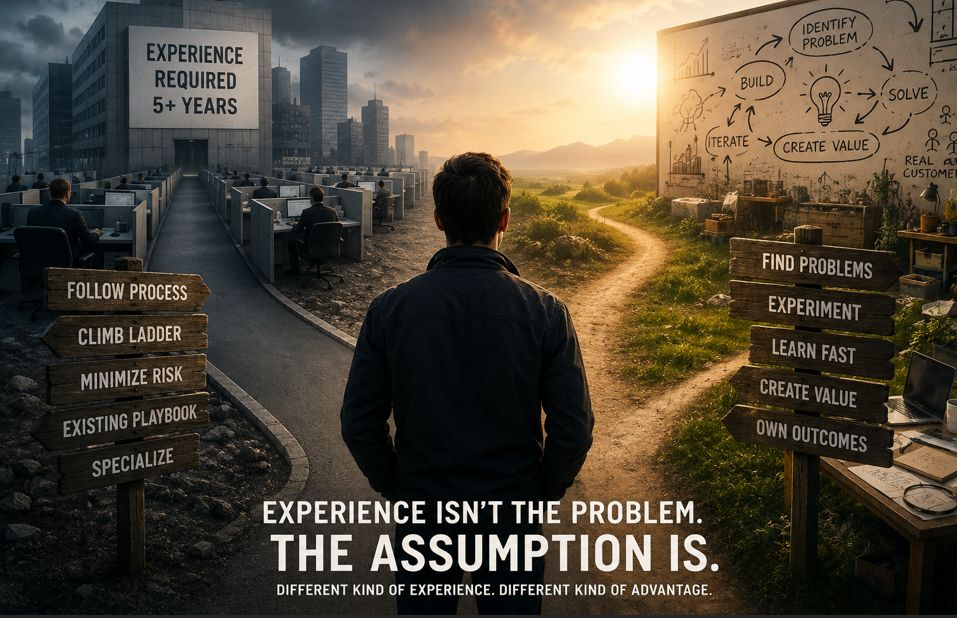
The school you attended was not designed to produce entrepreneurs. It was designed, deliberately and at scale, to produce workers.
As Relefy documented earlier this year in The World Was Built to Make You an Employee. That World Is Ending., the architecture of modern public education was a deliberate industrial project. Factory owners across England, France, Prussia, and the United States in the late 19th century needed workers who could read instructions, follow processes, and show up on time at scale. They lobbied governments to build the system that would produce them. Economists Oded Galor and Omer Moav, who research the relationship between human capital and industrial development, documented that what manufacturers needed from schools included not just literacy and numeracy but “work habits, such as punctuality, discipline, manners, and diligence.”
The school system delivered. By 1900, primary school enrollment across the industrialized world had transformed. England went from 11% of children aged 5 to 14 in school in 1855 to 74% by 1900. The same pattern repeated across France, Prussia, and the United States. The product was consistent: people who equated showing up with doing their job.
You spent twelve or more years inside that system. Then, in most cases, several years inside a job that ran on the same logic. Clock in. Produce visible output. Get evaluated. Repeat.
When you started your business, the system came with you.
The jail you built yourself
The typical early-stage founder does not suffer from a lack of discipline. They suffer from misdirected discipline. They build routines, schedules, task lists, and reporting structures that keep them busy from morning to evening. The business feels active. The calendar is full. The to-do list never empties.
None of it is random. It mirrors the structure of employment because that is the only structure most people have ever experienced. It produces the same feeling: the feeling of doing your job.
The problem is that employment and entrepreneurship are not the same job. In employment, showing up and completing assigned tasks is the deliverable. In entrepreneurship, the deliverable is outcomes. A founder can complete every task on their list for six consecutive months and move the business nowhere.
The tasks accumulate because they are easier to generate than to eliminate. Every new platform requires a posting schedule. Every client requires a check-in ritual. Every internal process spawns a meeting. Each individual task has a logic. In aggregate, they function as a cage. They consume the hours that would otherwise go toward the three or four things that actually determine whether the business survives.
The cage is invisible because it looks like work. And because the system you were raised in taught you that visible work is virtue.
The information layer makes it worse
The cage was already there before the internet. The information environment of the last decade made it structurally inescapable.
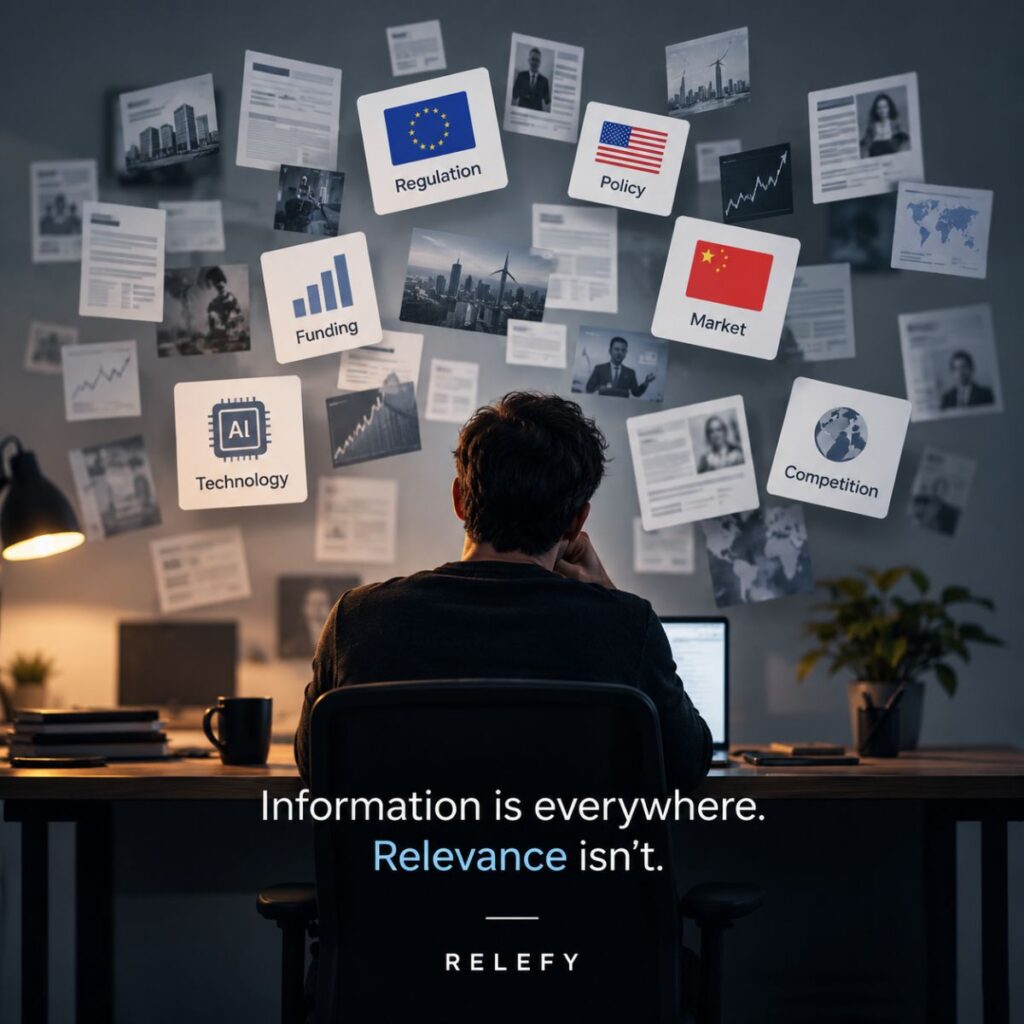
Founders in 2026 operate inside a continuous stream of content. Podcasts, newsletters, courses, YouTube channels, LinkedIn feeds, Slack communities. The knowledge is genuinely useful. None of it is the constraint.
The constraint is what the abundance produces: a permanent state of almost-ready. There is always one more framework to learn, one more case study to read, one more strategy to consider before the decision gets made. Consumption becomes a substitute for commitment. The founder who has listened to forty hours of sales podcasts has not made a single sales call. The research feels like progress. It produces none.
Social media adds a structural distortion on top of this. Platforms built for visibility reward consistent output. The dominant advice across every platform is: post every day or your audience disappears, engage constantly or the algorithm punishes you, be omnipresent or be invisible.
That advice is designed for people whose business is content. Most founders are not those people. For a founder running a consulting practice, a SaaS product, or a services business, the consistency tax extracted by three platforms, a newsletter, and a podcast is enormous. The return is often marginal. The opportunity cost is not.
What signal actually means
In the early 1990s, Kevin O’Leary, the Canadian investor and entrepreneur who built the educational software company SoftKey before selling it to Mattel for $3.7 billion, spent years working directly with Steve Jobs on educational software for Apple. O’Leary describes what he learned about how Jobs operated in this interview: Jobs defined his working day not by tasks completed but by a ratio. Signal was the three to five things that had to get done in the next eighteen hours. Everything else was noise. His target was 80% signal, 20% noise. The people O’Leary observed who reached a 50/50 split, he says, failed.
The signal-to-noise framework is not about working harder. It is about the discipline of elimination. Before you can execute on the three things that matter, you have to identify and refuse the thirty that don’t. That refusal is not natural. It is uncomfortable. It produces friction with collaborators, platforms, and the internal voice that equates stillness with failure.
Jobs addressed this directly at Apple’s Worldwide Developers Conference in 1997, in one of the clearest public statements on focus ever recorded. Jobs had just returned to Apple and was being challenged by an audience member about a cancelled product called OpenDoc, a software platform that a team had spent years building. Jobs’s answer became the frame: “When you think about focusing, you think focusing is saying yes. No. Focusing is about saying no. And you’ve got to say no, no, no.”
The hardest part of that, Jobs acknowledged, is that saying no produces conflict. People push back. The short-term cost of saying no is visible. The long-term cost of not saying it accumulates silently.
This is not a principle reserved for billion-dollar companies. It applies at the sole-trader level with equal force.
The pattern is not unique to entrepreneurs
The activity trap is not a startup problem. It is an institutional problem. Recognizing it in other contexts reveals how deep the structure runs.
At the Arctic15 conference in Helsinki on June 11, 2026, Lieutenant Colonel Timothy O’Toole of the United States Marine Corps, serving as Global Partnerships Director for Europe at the Defense Innovation Unit, described the same dynamic inside one of the largest and most resource-heavy organizations on earth. The US military’s procurement system, O’Toole told the room, was built for a world where governments controlled the supply of advanced technology. That world no longer exists. Private sector R&D spending in the US now accounts for 80% of total R&D spend. The most advanced technologies in AI, autonomy, and next-generation systems are being developed by commercial markets, not government laboratories.
The institution’s problem, O’Toole said, is not access to technology. It is adoption mechanism. The system’s internal activity — committees, approvals, program-of-record processes — was designed for a different century. It produces motion. It does not produce outcomes.
Founders will recognize the feeling.
The school system, the employment system, and military procurement all converge on the same error: mistaking institutional activity for institutional progress. The error is structurally reinforced because activity is visible and measurable, while the absence of the right activity is invisible until it is too late.
What to do with this
There is no clean checklist here, because the problem is not a missing process. It is a missing question.
The question is not: what should I be doing? Founders almost always know the answer to that. The question is: what should I stop doing, and what am I continuing because it produces the feeling of work rather than the outcome of work?
That question is uncomfortable to answer honestly. The posting schedule, the weekly reporting ritual, the check-in calls, the content strategy for a platform that has never converted a client: all of these have a logic. Each one is defensible in isolation. Collectively, they are the cage.
Jobs’s frame is the most practical available: write down the three things that must happen in the next eighteen hours for the business to move. Everything not on that list is a candidate for elimination. Not deprioritization. Elimination.
The measure is not whether a task is good or useful. The measure is whether it is signal. Useful tasks that are not signal consume the same hours as useless ones.
The entrepreneurs who build something significant are almost never the most active ones. They are the ones who learned, earlier than most, that focus is a subtractive skill. The work is not to add. The work is to cut until only the load-bearing structure remains.
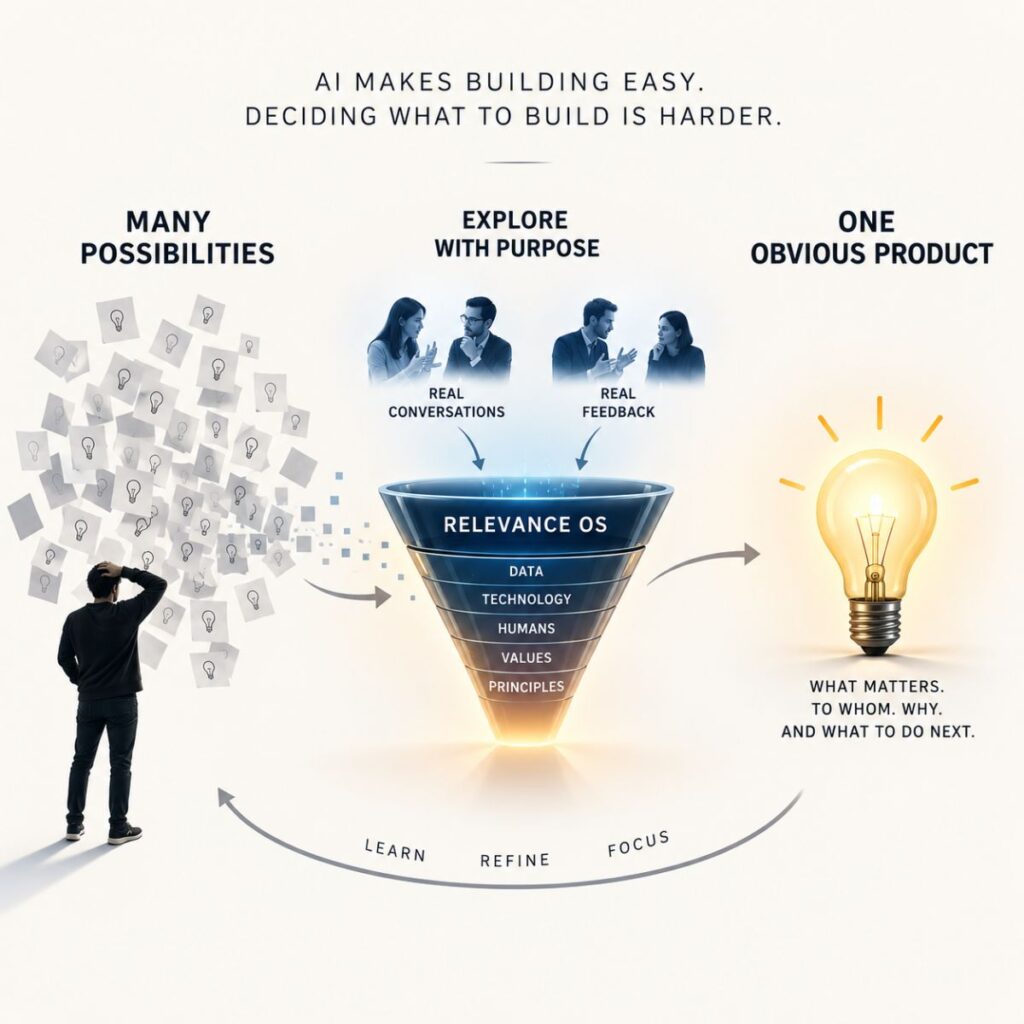
In a world of abundant information, the problem is no longer access. It is filtration. Signal exists. Finding it requires cutting through a continuous stream of noise that is structurally designed to keep you consuming rather than building.
That is what Relefy is built to do: filter out the noise and surface the signal that actually matters for people who are building something. If that is useful to you, register at relefy.io and get the signal you need.