Ask a founder what’s wearing them down and they’ll usually name a decision: which hire to make, which market to enter, whether to raise now or wait. The decision is rarely the actual problem. What’s wearing them down is everything they felt obligated to read, check, and weigh before they let themselves make it.
A 2026 Patriot Software survey of 1,000 US small business owners found that 53.5% lose sleep over the business at least a few times a week, 47.7% have skipped or delayed their own paycheck to keep it running, and 84.4% report sacrificing health, relationships, or wellbeing for the work. Those numbers describe financial and physical strain. They don’t yet explain where the strain comes from. For that, an older and less founder-specific study is more precise than it first looks.
In January 2023, before generative AI had reshaped how anyone works, Oracle and data scientist Seth Stephens-Davidowitz surveyed more than 14,000 employees and business leaders across 17 countries for a study called The Decision Dilemma. Seventy-four percent said the number of decisions they made daily had grown tenfold in three years. Eighty-five percent had suffered what the study called decision distress, regretting or second-guessing a call from the past year. Seventy percent had abandoned a decision entirely because the volume of input made it impossible to reach one. The study wasn’t about founders and it wasn’t about AI. It was about a more basic mechanism: past a certain point, more available information doesn’t improve a decision, it delays it.
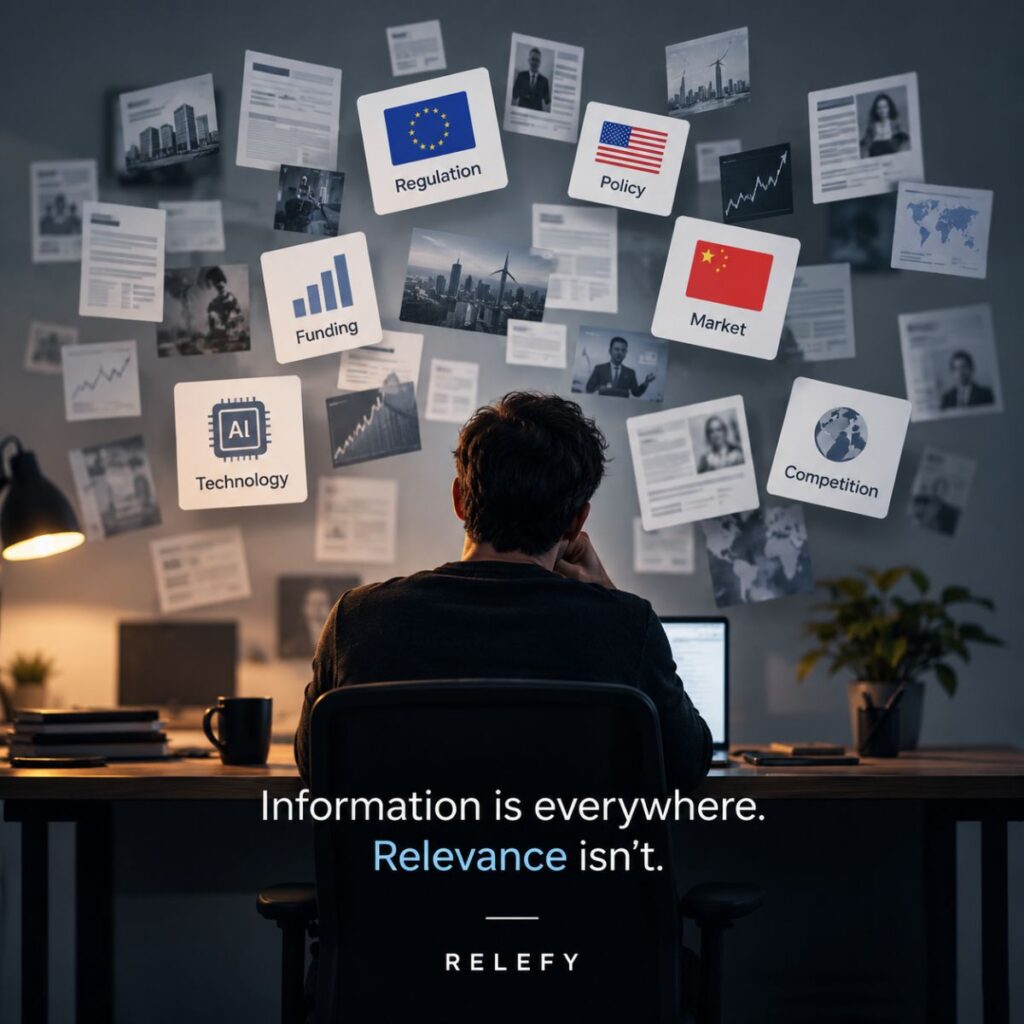
That mechanism predates the current AI wave, and it points at something more specific than volume alone. The issue isn’t only that there’s more information now. It’s that most of that information doesn’t announce whether it applies to you. A founder scanning the news doesn’t get a fact tagged “relevant to your decision” and a fact tagged “safe to ignore.” They get an undifferentiated stream, and the work of sorting one from the other is exactly the work that gets skipped when there’s too much of it. Regulation is the clearest place to watch this happen, not because it’s the biggest source of overwhelm, but because it’s the fastest-growing category right now, and because the gap between information and relevance shows up in it with unusual clarity.
Start with what’s simply true, at the level of a headline. The EU’s AI Act banned a specific set of practices, including the social scoring provision, starting February 2025. A separate set of transparency obligations, covering chatbot disclosure and synthetic content labelling, becomes enforceable in August 2026, eighteen months later, under the same law. The US is legislating AI state by state rather than federally. Several Asian governments are moving in the opposite direction, building AI infrastructure and national strategy rather than restricting use. A Relefy piece from May 2026, “Three Continents, Three Priorities, One AI Race,” compressed this into a clean macro signal: Asia building, Europe regulating, America deregulating. As a way of reading the world at a glance, that signal is genuinely useful, Singapore and Taiwan really are moving faster on AI infrastructure and adoption than most of Europe.
But no founder makes a decision at the level of a glance. They make it standing in front of one specific product, in one specific market, and the macro signal doesn’t survive that zoom without being checked. China’s Interim Measures for the Administration of Anthropomorphic AI Interaction Services, effective July 2026, ban AI companion and virtual-relationship services for minors and require algorithm filing and security assessment from any provider, including foreign ones serving Chinese users. Read as more evidence that “Asia regulates too,” this is just another data point to log. Read against an actual founder, it splits in two. For a founder building a normal B2B productivity tool, the rule is close to irrelevant, the measure was narrowed specifically to carve out tutoring and productivity AI, and the obligations attach to emotionally interactive products, not AI generally. For a founder building anything with a companion or emotional-engagement layer, exactly the same regulation is close to existential, and arrives with less warning than a slower-moving jurisdiction like the EU gives. Same fact. Same week. Two founders, two entirely different amounts of it that matter.
That’s the distinction most compliance reading skips. Knowing that China introduced another AI regulation is information. Knowing that it specifically targets emotionally interactive AI, with defined carve-outs for other categories, is context. Whether either of those changes anything for the founder reading it depends entirely on what they’re actually building, and that last step, the one that turns context into relevance, is for many hard to scale and the one most people never get to, because they’re still working through the information.
This is the part worth being precise about, because it’s easy to overcorrect into the wrong lesson. The answer isn’t that regulation doesn’t matter or that founders should stop tracking it. Some of it is genuinely binding and genuinely consequential to ignore, and the China example cuts both ways for exactly that reason. The mistake is treating full understanding of every live category, regulatory, competitive, technological, as a prerequisite for acting, when the volume in each category is now growing faster than any one person can fully absorb it. That standard was already failing founders in 2023, when the categories were fewer and slower-moving. It fails harder now that AI-specific regulation alone adds a category that didn’t exist three years ago and is still being written in real time across a dozen jurisdictions simultaneously, each with its own carve-outs and exceptions that only apply to some builders and not others.
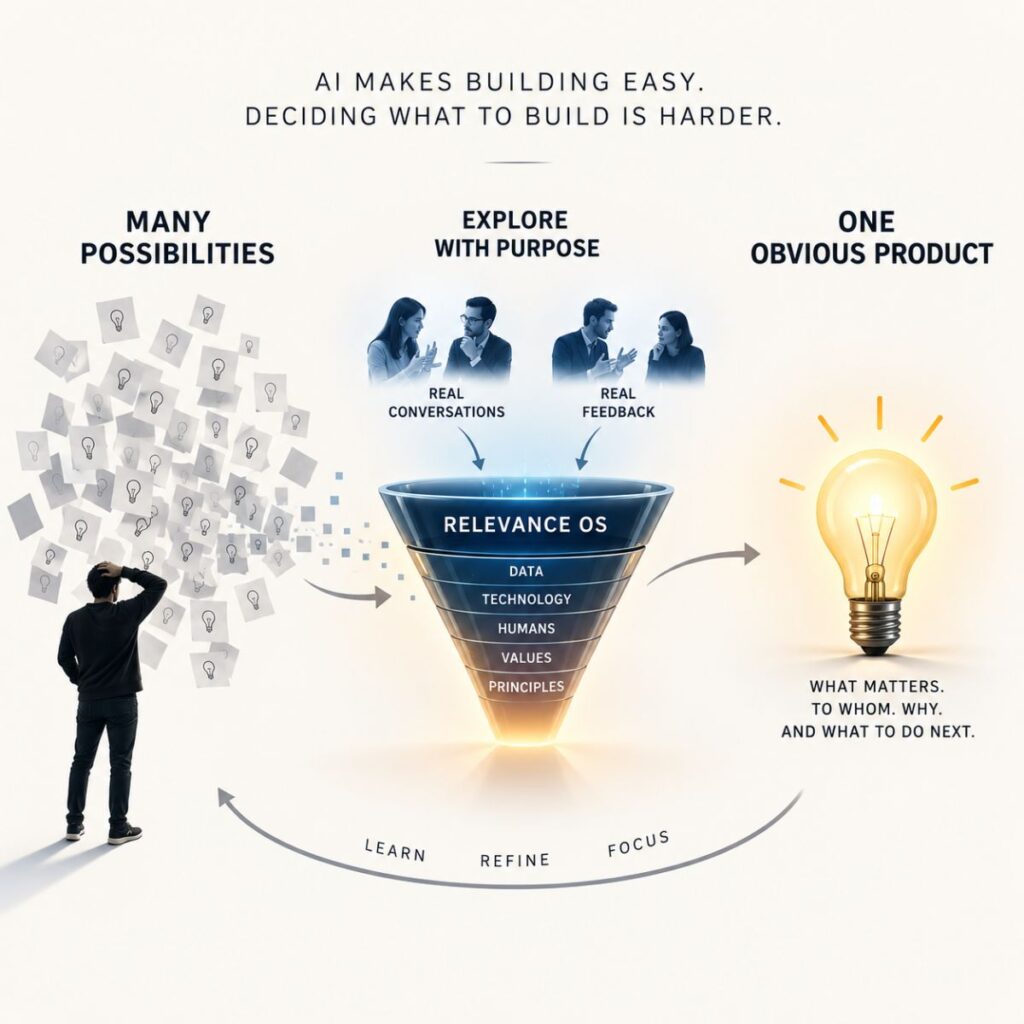
The founders who aren’t stuck aren’t the ones who’ve resolved the volume. They’ve made a narrower decision first: which slice of everything available is actually relevant to what they’re building, and which is noise wearing the costume of due diligence. That’s a filtering problem, not a research problem, and it’s a different skill than reading more. It’s the skill of asking, of every new piece of information that lands, what does this actually change for me, before spending time finding out everything about it.
The volume is not going to shrink. Every year adds more regulation, more competitors, more AI-generated content to sort through, more of everything that looks like it needs checking before the next move. The competitive advantage isn’t having more information than everyone else. The problem isn’t knowing what’s happening. It’s knowing which part of what’s happening changes what you should do, and how quickly you can tell the difference before the decision is overdue anyway.
Sources
Patriot Software, “Half of Small Business Owners Skip Their Own Paycheck to Survive”, 2026 survey of 1,000 US small business owners
Oracle and Seth Stephens-Davidowitz, The Decision Dilemma, January 2023 global study of 14,250 employees and business leaders across 17 countries; summarised in Agility PR Solutions, “Decision distress: Drowning in data”
EY, “AI Act: Prohibited AI Practices Become Applicable”, on Article 5 and Article 50 enforcement dates
Relefy, “Three Continents, Three Priorities, One AI Race”, May 2026
IAPP, “China’s regulation on AI companions takes force”, on the Interim Measures for the Administration of Anthropomorphic AI Interaction Services, effective 15 July 2026
AI Safety China, “China bans AI partners for minors and lays out AI agent threats”, on the narrowed scope and productivity/tutoring carve-outs in the final rule